Chief Operating Officer
About Fractional COO: Strategic Leadership and Operational Scaling Operations Management: Systems and Processes for Scalable Growth Search Feeds Also on Micro.blog
  • Shadow IT Is an Accountability Problem, Not a Security Problem
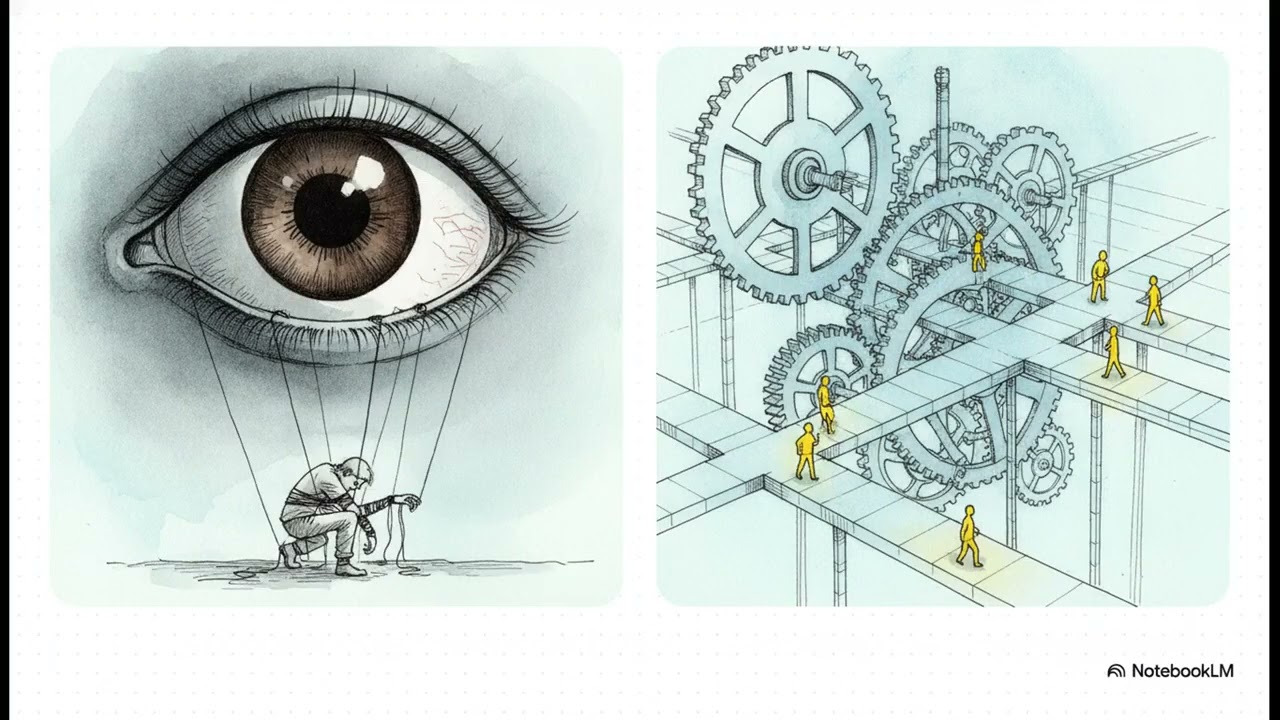
    Shadow IT Is an Accountability Problem

    Shadow IT is usually classified as a security failure and answered with prohibition. The classification is wrong, and the response follows the classification. When the sanctioned path runs slower than the work, people route around it, and that routing is a signal about where decision rights sit rather than evidence of indiscipline.

    Rigid governance manufactures the thing it fears

    Centralized approval removes real-time risk ownership from the people holding the situational context needed to judge it. That ownership transfers to a committee that does not hold the context and cannot acquire it at the speed the decision requires.

    The committee therefore applies a general rule, because a general rule is the only instrument available without specific knowledge. The general rule does not fit the specific case. The operator, who can see that it does not fit, now chooses between a process that blocks the work and a workaround that completes it.

    Leadership meanwhile observes dashboards reporting green. Those indicators track process compliance rather than the condition they claim to represent, which is why the reassurance they provide is unrelated to actual exposure.

    The shadow organization is a structural output

    Latency accumulates in any approval chain, and it accumulates fastest where the chain was designed for a different risk profile than the work now carries. Where the official path reliably costs more time than the task itself, an unofficial path forms to absorb the difference.

    That unofficial path is the shadow organization. It is a structural consequence rather than a cultural failing, and it appears in disciplined organizations as readily as in careless ones. The variable is process latency, not employee character.

    Prohibition does not remove the pressure that created it. Prohibition removes visibility into it, which converts a known workaround into an unknown one. The risk profile worsens while the compliance report improves.

    Normalization of deviance

    The sociologist Diane Vaughan described the process by which the boundary of acceptable behavior widens incrementally. Each deviation that produces no immediate failure becomes evidence that the deviation is safe, and the revised boundary becomes the new baseline for the next decision.

    Vulnerability accumulates quietly under this mechanism. The organization is not aware of drifting, because at every individual step the drift was small and the outcome was acceptable. Nobody made a reckless decision, and the aggregate position is nonetheless reckless.

    This is why shadow IT resists periodic crackdowns. A crackdown resets behavior without resetting the latency that produced it, so the drift restarts from the same origin on the same gradient.

    Systems and surveillance are opposite responses

    Surveillance assumes people are the risk and answers with monitoring, approval gates, and manual review. Every action requires human inspection, which produces a hidden factory of rework and delay while addressing none of the underlying condition.

    Systems assume the structure is the risk. Security embedded into the default path means the safe route and the fast route are the same route, and compliance stops competing with delivery for the same hour.

    The distinction is testable. Where a control requires someone to remember it, the control is surveillance. Where a control operates whether or not anyone remembers, it is a system, and only the second survives sustained time pressure.

    Governed activation in practice

    Governed activation is the operating pattern that replaces gate-based control. It has four components, and the value comes from installing all four rather than the strongest one.

    Explicit decision rights come first, meaning every recurring category of technology decision has a named owner rather than a committee. Second, protective controls are built into execution rather than layered on top of it, so the safe path requires no additional step. Third, each outcome carries a single named owner who holds the consequence. Fourth, a review rhythm runs on a fixed schedule rather than on request.

    The fourth component does the quiet work. A scheduled review removes the incentive to avoid raising an issue, because raising it costs nothing that waiting would not also cost.

    Frameworks that describe the same structure

    The RACI model separates responsible, accountable, consulted, and informed roles, and its practical value here is forcing a single accountable name onto each decision class. Most implementations dilute that by assigning accountability to a group, which reproduces the committee problem inside the framework meant to prevent it.

    Zero-trust architecture makes the same structural argument in security vocabulary. It assumes the perimeter will be crossed and designs for verified access at each point rather than for a single guarded boundary. The organizational parallel is exact. Assume the process will be routed around, and design the sanctioned path so routing around it produces no advantage.

    The Theory of Constraints supplies the sequencing logic. Improving anything other than the binding constraint produces no throughput gain, and in most approval structures the binding constraint is decision latency rather than technical capacity.

    Where the latency actually accumulates

    Approval latency concentrates in three places, and measuring them is cheaper than debating them. Working through the three in order usually locates the binding one within an afternoon.

    The first is consent depth, meaning how many separate people must agree before work may begin. Each additional consent adds waiting time rather than judgment quality, and the marginal reviewer contributes least. Count the consents on a recent request and compare that number against the request’s actual exposure.

    The second is context distance, meaning how far the decision travels from the person who understands the situation. Every step of that distance requires a translation, and translations lose detail reliably. Shorten the distance where possible and document the interface where the distance is unavoidable.

    The third is queue rule absence, meaning whether incoming exception requests are ordered by a stated rule or by who asked most recently. Without a rule, urgency substitutes for importance and the loudest request wins. Aligning the queue to stated risk criteria restores order without adding reviewers.

    Alignment is what makes the sanctioned path faster

    Operational excellence in this domain is not stricter control. It is the condition where the fastest available route is also the approved one, which removes the incentive that produces shadow systems in the first place.

    That condition requires shared agreement about which risks actually matter. Where security, operations, and delivery hold different risk models, the organization enforces all three simultaneously and the combined path becomes slower than any single one would be. Coherence between those views does more for stakeholder value than any additional control layer.

    Continuity holds the gain. A path optimized once and left unmonitored accumulates new consent steps, because each individual addition looks reasonable in isolation. Periodic re-examination of the path itself, rather than of compliance with it, is what prevents the slow return of the original condition.

    Conditional rules for routing decisions

    Where a decision requires judgment about a specific situation, route it to a single named risk owner rather than to a committee. Committees are appropriate for policy and structurally unsuited to instances.

    Where a compliance control requires a separate manual action to complete, the control is not embedded and will be bypassed under time pressure. Rebuild it into the default path rather than reinforcing the reminder.

    Where ambiguity exists about who may approve an exception, speed collapses regardless of how the remainder of the process is designed. Removing the ambiguity restores it, and this is usually a documentation task rather than a reorganization.

    Speed is a safety feature

    Organizational safety does not come from performative committees or accumulated documentation. It comes from the capacity to detect a problem and act on it before it compounds, and that capacity is a direct function of decision speed.

    The inversion is worth stating plainly. A slow organization is not a careful one. It is an organization whose response time to a genuine problem is also slow, and the same latency that delays a software purchase delays an incident response.

    Rigor is compatible with speed where the rigor lives in the structure rather than in the review. Calm, consistent, pre-decided rules produce faster and better outcomes than case-by-case deliberation under pressure.

    Structure protects the operators inside it

    The argument for correcting this is not only exposure management. Staff working around a process carry personal risk for a decision the structure declined to make, and they carry it without acknowledgment or protection.

    That erodes trust and human capital simultaneously. People will absorb a demanding workload. They will not indefinitely absorb responsibility for outcomes they were never authorized to control. Servant leadership expressed operationally means placing the decision where the context sits, and then standing behind it.

    Shared understanding of who decides what is what allows technical staff to raise problems early. Where that understanding is absent, raising a problem carries ambiguous consequence, and the rational response is silence.

    The question worth asking honestly

    The useful examination is not how to eliminate shadow IT, because shadow IT is a symptom and symptoms are poor targets. It is whether the sanctioned path is faster than the workaround, because that ratio determines behavior more reliably than any policy.

    Compliance rituals should be assessed against the same standard as any other process. Ask whether each one protects the business from material risk, or protects leadership from discomfort about risk it cannot see. The two feel identical from inside a review meeting and produce opposite outcomes.

    Governance that compounds is governance that makes the correct action the easy action. Every control built that way accumulates, and the accumulated effect is an organization where speed and safety stop being a trade.

    Watch the full explainer

    https://youtu.be/4p7iq5Alb6I

    Related

    Further material on operations and fractional executive leadership from Kamyar Shah: kamyarshah.com

    For an operational diagnosis of a specific situation, the free diagnostic is at businessconsultant.services
    → 7:14 AM, Aug 3
  • Cost Cutting That Does Not Cut Cost

    Cost Cutting That Does Not Cut Cost

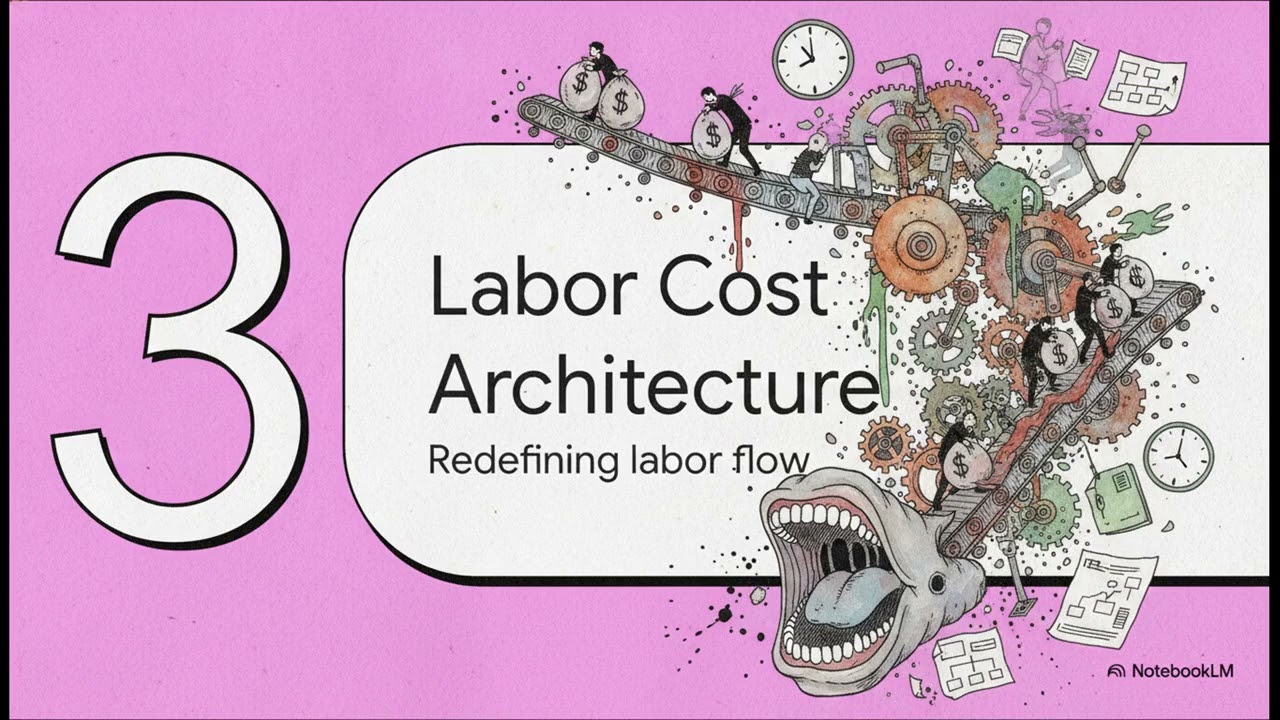
    When margin tightens, the reflex is to reduce headcount. Structurally that sequence is inverted. Cutting people without first auditing the process architecture removes capacity while leaving the work in place. The work then reappears somewhere less visible and more expensive.

    Two kinds of labor sit inside the same payroll line

    Value-producing labor generates output. It is the work that would still exist if every system in the organization functioned perfectly. Most cost analysis treats the entire payroll as this category, which is where the error begins.

    Compensating labor exists only to bridge gaps where protocols should be. Someone moves data between systems that do not talk to each other. Someone chases an approval that was never formally defined, or rebuilds a report because the source of record is ambiguous.

    None of that work produces output. All of it is indistinguishable from real work on a headcount line, which is why it survives every review that starts from the payroll rather than from the process.

    Compensating labor is a symptom of missing structure rather than a category of role. Removing it without repairing the structure relocates the work rather than eliminating it. The relocation is usually to someone more senior and more expensive.

    Why the headcount reflex fails structurally

    Reducing headcount treats a symptom and leaves the mechanism intact. The ability to execute reliably depends on the system underneath the people. Organizations that never build an operating system to replace direct founder oversight push all that coordination back onto individuals by default.

    The failure runs in a predictable sequence. Protocols are absent, so people compensate manually, and manual compensation consumes senior attention because escalation is the only available resolution path.

    The executive calendar then fills with internal coordination rather than external growth. Growth slows, margin tightens further, and the reflex fires again.

    Each cycle removes capacity while leaving the generating mechanism untouched. This is why cost reduction programs frequently produce a second cost reduction program eighteen months later. The first one addressed the expression rather than the cause.

    Task decomposition comes before any cut

    The corrective work starts with mapping rather than with a target number. Every recurring task gets sorted into value-producing and compensating categories. This is slow, and rushing it undermines everything downstream, because the entire subsequent decision depends on the accuracy of the split.

    Two rules make the sort reliable and repeatable. Ask what the task would look like if every adjacent system worked correctly, since compensating work disappears entirely under that condition. Then follow the task backward to the gap it exists to bridge. Compensating work always has a specific structural origin, and rigor in tracing it is what separates a real audit from a guess.

    The output is not a list of people. It is a list of structural gaps with the labor cost of each attached. That inversion is what converts a cost conversation into an operations conversation.

    Process assignment turns the map into action

    Where compensating labor exists because decision rules were never documented, the correction is documentation rather than headcount change. Writing down who decides what, and under which conditions, removes the escalation traffic that consumed the time. This is the cheapest intervention available and it is routinely skipped because it produces no visible artifact.

    Where ambiguity between departments generates constant clarification, the correction is handoff protocol definition. A handoff protocol specifies what moves, in what state, to whom, and what constitutes acceptance. Most interdepartmental friction resolves once acceptance criteria exist, because the friction was never disagreement but undefined completion.

    Where the compensating work bridges two systems that do not integrate, the correction is either integration or a documented manual protocol with a named owner. Leaving it undefined guarantees the work continues invisibly and gets attributed to someone’s workload rather than to the gap.

    Naming the frameworks that make the split legible

    Lean methodology draws exactly this distinction and calls the second category waste, specifically the waiting, motion, and defect categories that describe compensating work with precision. The value of naming it that way is that it moves the conversation off people and onto the process that produces the work.

    Activity-based costing supplies the other half. Conventional cost accounting assigns expense to departments. Activity-based costing assigns it to the activity consuming the resource, which makes compensating labor visible as a line rather than as an assumption. The two together turn an opaque payroll figure into an itemized structural bill.

    A simple value stream map is usually enough to start. Following one recurring output from request to delivery and marking every wait, handoff, and rework loop exposes more compensating labor in an afternoon than a quarter of budget review. Consistency in how the map is drawn matters more than sophistication in the tooling.

    Where alignment does the financial work

    Cost structure and strategic fit are the same conversation held in different vocabulary. A cost base aligned to what the organization actually does is smaller than one carrying the residue of what it used to do. Most cost bases carry more residue than anyone has measured.

    Shared understanding of which activities are differentiating is the precondition for that alignment. Where finance, operations, and delivery hold different answers to that question, the organization funds all three interpretations simultaneously. Coherence between those views is worth more than any single reduction target, because it determines which reductions are even the right candidates.

    Continuity matters here too. A cost base corrected once and left unmonitored drifts back, since the structural gaps that generated compensating labor regenerate it as soon as attention moves. Calm, periodic re-examination holds the gain better than an aggressive one-time programme.

    Choosing the right kind of external help

    Once structural gaps are visible, buying the wrong kind of external help wastes capital efficiently. The distinction that matters is between analysis and installation, and it is frequently blurred during the purchase.

    An adviser who delivers analysis produces a document and a set of recommendations. That is useful where the constraint is knowledge, meaning the organization does not know what to do. An operator who builds execution infrastructure produces a functioning system. That is required where the constraint is capacity, meaning the organization knows what to do and has nobody with the authority and time to install it.

    Confusing the two guarantees mismatched expectations on both sides. The resulting disappointment gets attributed to the individual rather than to the category error that produced it, which means the same mistake gets repeated with a different name.

    Conditional rules for capital allocation

    Each of the following is a diagnostic rather than a preference, and each maps a specific constraint to a specific intervention.

    Where decisions have no owner and no rhythm, the intervention is structural rather than advisory. Coaching an individual will not install a decision cadence, and a strategy document will not name owners.

    Where the constraint is individual leadership patterns rather than organizational structure, executive coaching addresses it and process work will not. These two look similar from the outside and respond to opposite treatments. Steadiness in telling them apart saves more capital than speed in choosing between them.

    Where necessary work sits outside the organization’s core competency, outsourcing is more direct than internal capability building. Building durable internal capability for work that will never differentiate the business is a slow way to spend money. Where the work is differentiating, the reverse holds and outsourcing it exports the advantage.

    Red flags that the diagnosis was wrong

    Where an intervention has been running for a full cycle and the underlying friction has not moved, the problem architecture was misidentified at the start. The common response is to fund the same intervention harder, which compounds the original error rather than correcting it.

    A second flag is displacement. Costs fall in the measured category and rise in an unmeasured one, which indicates the work was relocated rather than eliminated. This is the signature outcome of cutting compensating labor without repairing the gap, and it is invisible to any report scoped to the original category.

    A third flag is the return of the same conversation. Where a cost reduction discussion recurs on a predictable interval, the organization is treating a structural condition as a periodic event. The interval itself is the diagnostic.

    Cost discipline protects people rather than pressuring them

    The argument for this approach is not only financial. Compensating labor is experienced by the people performing it as low-value work that nobody acknowledges, because it produces no output anyone can point to. That erodes human capital quietly and steadily.

    Removing the structural gap removes that work, which is materially different from removing the person doing it. Servant leadership expressed in operational terms means fixing the system that generates meaningless work rather than asking people to absorb it with better attitude. Trust in an organization tracks whether difficult decisions are made on structure or on convenience.

    Teams distinguish between a company that cuts cost and a company that removes waste, and the distinction shows up in what happens to the survivors' workload. Where the work remains and the people do not, the message is unambiguous.

    The question worth asking instead

    The useful question is not how much can be cut, because that framing assumes the current cost base is a single undifferentiated quantity. It is not, and treating it as one guarantees the wrong reduction.

    The useful question is how much of the current cost base exists only to compensate for structure that was never built. That figure is knowable, it is usually larger than expected, and it can be removed without removing capacity. Answering it requires the decomposition work that cost pressure makes everyone want to skip.

    Cost discipline compounds the same way operational discipline does. Each structural gap closed removes its associated labor permanently rather than for one budget cycle, and the accumulated effect is a cost base that does not require periodic emergency correction.

    Watch the full explainer

    https://youtu.be/C5MiaNBJkhE

    Related

    Further material on operations and fractional executive leadership from Kamyar Shah: kamyarshah.com

    For an operational diagnosis of a specific situation, the free diagnostic is at businessconsultant.services
    → 7:14 AM, Aug 3
  • The IT Operations Bottleneck Is Rarely Technical

    The IT Operations Bottleneck Is Rarely Technical

    Most operational bottlenecks get diagnosed as capacity or tooling problems and treated by adding one or the other. Where the constraint is structural rather than technical, adding capacity makes the condition worse. Every additional person increases coordination load faster than it increases productive output.

    Headcount scaling and operational scaling are different actions

    Headcount scaling manages friction. More people absorb more of the same overhead, and the underlying system continues generating it at the same rate. The friction is not reduced, only distributed across a larger payroll, which is why the relief from a hiring round tends to fade within two quarters.

    Operational scaling changes the system so that the friction stops being produced at all. The existing team then delivers disproportionately more without any addition to headcount. Organizations reliably attempt the first when the situation calls for the second, because hiring is visible and system repair is not. Diagnose which one the constraint actually requires before approving either.

    Coordination collapse

    Early stage organizations run on informal proximity, and they run on it well. Everyone holds roughly the same context because everyone sits close enough to absorb it without a documented process. This works genuinely rather than accidentally, and its success is precisely what makes the eventual failure surprising to the people inside it.

    Coordination collapse is the point where organizational complexity outpaces that mechanism. One team now holds context another team lacks, so work that used to move on assumption requires explicit negotiation. The symptom presents as a communication breakdown. The cause is structural growth past the range where proximity worked.

    Treating the symptom produces more meetings. Treating the cause produces documented context that does not depend on who happens to be in the room. Operational excellence at this stage is mostly the discipline to write things down before the calendar absorbs the alternative. Build the second before the first consumes the week.

    Decision latency

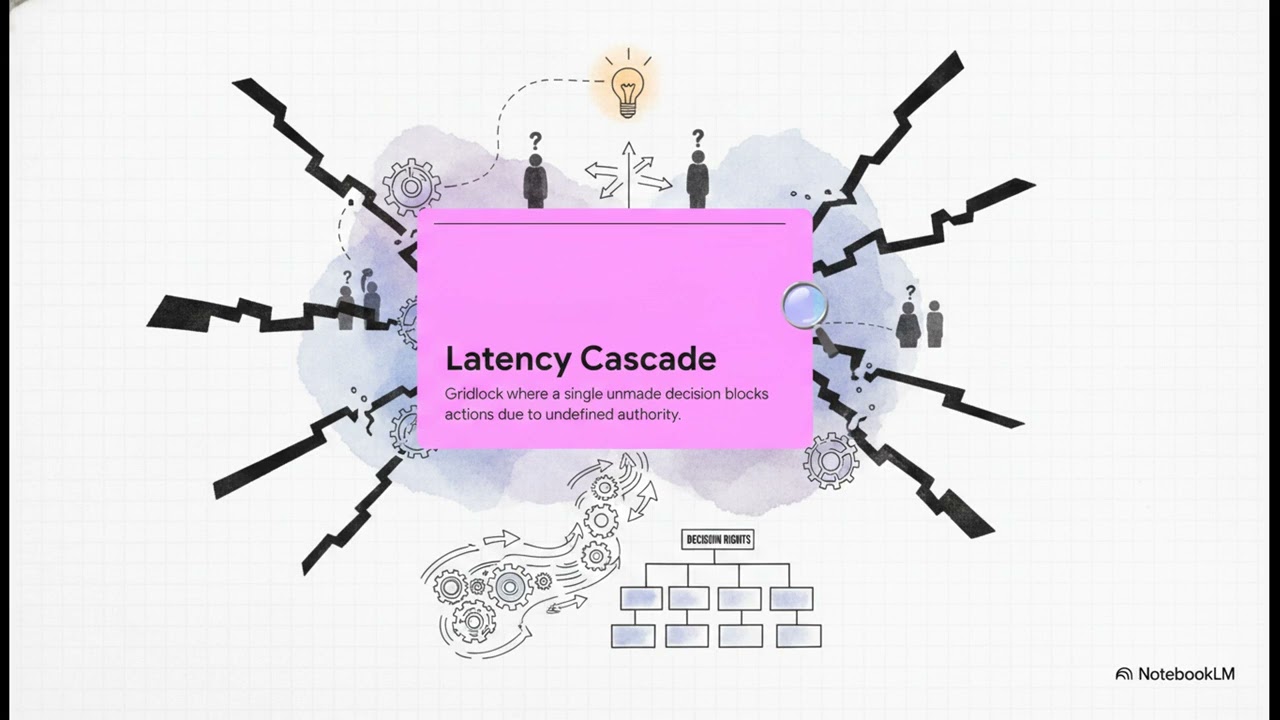
    A second failure mode appears where decision rights were never defined. A single unmade decision blocks a long chain of dependent work. Because nobody is certain they hold the authority, routine decisions escalate upward by default.

    Without a documented operating rhythm that forces choices on a schedule, delay becomes the resting state. Leadership then experiences its calendar filling with decisions that should never have reached that level. The escalation is not a discipline failure. It is a rational response to unclear authority, and it will continue until the authority is made explicit.

    Decision latency compounds differently from other operational drag, and the difference matters for triage. Capacity problems slow work proportionally, so doubling the load roughly doubles the delay. Latency problems stop work entirely until the decision arrives, regardless of how much capacity sits idle behind the block. Treat latency as the higher priority, because it wastes capacity that has already been paid for.

    The premature automation trap

    This is the most expensive version of the mistake in a technology context. Software gets deployed on top of a process nobody has examined. The purchase feels like progress because it is concrete, dated, and easy to report.

    Automating a wasteful process does not remove the waste. It produces that waste faster and more consistently, and now carries a licence cost alongside it. Diagnosis has to precede prescription, and composure at that moment is worth more than speed.

    A related failure runs quieter and lasts longer. Where the strategic process requires one outcome and the daily workflow is sequenced for a different one, the organization generates continuous drag that nobody can locate. No tool resolves this, because the tool is faithfully executing the wrong sequence. Strategic fit between intent and workflow is checked far less often than either is checked alone, and the gap between them is where most operational cost hides.

    The improvement sequence that holds

    Lean methodology and Six Sigma disagree about a great deal, and they agree about order. Both require that waste be identified before it is engineered against, and both treat measurement as a precondition rather than a reporting exercise. The Theory of Constraints goes further and argues that improving anything other than the binding constraint produces no throughput gain at all. That shared premise is the part worth carrying into any operations decision.

    Uncover the hidden drag forces first, which usually means watching the work rather than reading the process document. Define the improvement target second, in observable terms. Redesign the process structurally to eliminate what was found, third. Only then consider tooling.

    Reversing this order produces the common outcome: a modern system performing an obsolete process, and an organization concluding that the system failed. The system did not fail. It was installed at the wrong point in the sequence.

    Conditional rules for choosing the intervention

    Match the intervention to the actual constraint rather than to the most available solution. Each of the following is a diagnostic, not a preference.

    Where variation in how a necessary task gets performed is the problem, standardize the output before automating anything. Six Sigma logic applies when the defect is inconsistency rather than speed. Where tasks generate friction but sit outside the organization’s core competency, structured outsourcing addresses it more directly than internal process work. Building internal capability for work that will never be differentiating is a slow and quiet way to spend money.

    Where the environment is uncertain and the correct sequence is not yet known, standardization is premature and will lock in a guess. Locking in a guess costs more than tolerating variation for another quarter, because the guess acquires defenders once it has been documented. Wait for the pattern to stabilize, then standardize what the work has already proven. Consistency of judgment here compounds.

    What operational coherence actually looks like

    Coherence is the condition where the strategic intent, the documented process, and the daily behavior all describe the same activity. Most organizations hold all three and no alignment between them, which is why process documentation so often surprises the people it supposedly describes. The gap is not dishonesty. It is drift that nobody was assigned to notice.

    The test is inexpensive. Ask three people at different levels to describe how a specific recurring decision gets made. Where the answers diverge, the process document is fiction and the real process lives in individual habit. That divergence is the operational debt, and it accrues interest in the form of coordination time.

    Systems exist to make behavior repeatable without supervision. A process that only functions when a specific person is watching is a dependency wearing a system’s paperwork. That distinction determines whether the organization can grow past its most senior operator. Remove that participant on paper and ask what happens next.

    Where the constraint usually sits in a technology function

    Technology operations concentrate their constraints in three places, and the distribution is consistent enough to be worth checking in order. Working through them in order usually locates the binding one. Skipping the sequence applies effort where it changes nothing.

    The first is approval depth, meaning the number of separate consents required before work can start. Each consent adds latency rather than capacity. Count the consents on a recent piece of work and compare that number to its actual risk.

    The second is context ownership, meaning whether the person who understands a system is the same person authorized to change it. Where those separate, every change requires a translation step, and translation steps lose information reliably. Reunite them where possible and document the interface where not.

    The third is queue discipline, meaning whether incoming work is prioritized by a rule or by whoever asked most recently. Absent an explicit rule, urgency substitutes for importance. Install the rule before adding people to the queue.

    Measure the system, not the effort

    Most operational reporting measures activity because activity is easy to count. Tickets closed, deployments shipped, meetings held. None of those indicate whether the system underneath is improving or degrading, and a team can raise all three while the operation gets worse. Activity metrics answer whether people are busy, which was rarely the open question.

    The measures that matter are structural. Time from request to decision exposes latency, proportion of work requiring escalation exposes unclear authority, and rework rate exposes ambiguous handoffs. Each describes the system rather than the people operating it. Each moves when the structure changes rather than when the team works harder.

    Balanced Scorecard logic applies in its original sense, which is that a single measure invites gaming while a small balanced set does not. Pick three structural measures and hold them stable long enough to see a trend.

    Structure protects the people inside it

    The argument for fixing this is not efficiency alone. Ambiguous process is absorbed by staff as personal risk, and human capital erodes under sustained ambiguity faster than under sustained workload. People tolerate a heavy quarter. They do not indefinitely tolerate not knowing whether their judgment will be supported.

    People who do not know how a decision gets made will either escalate it, wait for it, or work around it. Each response costs them time and standing, and none of the three is visible on a report. Servant leadership expressed operationally means removing that ambiguity rather than encouraging people to tolerate it.

    Trust follows structure more reliably than structure follows trust. Teams extend confidence to a system that behaves predictably, and predictability is a design output rather than a cultural aspiration. Culture work on a structural problem produces goodwill that decays at the next ambiguous decision. Fix the structure and the culture question answers itself.

    Fix the system before the crisis forces the choice

    Waiting until informal proximity collapses entirely, or until decision latency cascades into visible failure, means the restructuring happens under crisis conditions. Crisis restructuring is more expensive and produces worse decisions, because the same coordination capacity that failed is now being asked to redesign itself.

    The disciplined version is unglamorous. Map where context actually lives, then name who decides what. Install a rhythm that forces those decisions on a schedule rather than on escalation. Each element compounds, and the accumulation is what people later describe as a well run operation.

    The question worth putting to any growing organization is narrow. It is not whether the team is working hard enough, because it almost always is. It is whether the organization is adding capacity to a system that consumes it. The alternative is repairing the system and releasing the capacity already locked inside the friction.

    Watch the full explainer

    https://youtu.be/_gv_D2zRA40

    Related

    Further material on operations and fractional executive leadership from Kamyar Shah: kamyarshah.com

    For an operational diagnosis of a specific situation, the free diagnostic is at businessconsultant.services
    → 7:14 AM, Aug 3
  • IT Governance Without a CIO Is a Decision Rights Problem

    IT Governance Without a CIO Is a Decision Rights Problem

    IT governance in a company without a CIO fails for structural reasons rather than technical ones. The common correction is more process: additional committees, longer review cycles, heavier documentation. That structure produces the appearance of control while removing the single condition execution actually requires, which is a named owner holding the authority to decide.

    The bottleneck sits in authority, not capability

    Consider a leadership team that communicates openly and holds real technical competence across its functions. Vendor renewals still slip past their dates, and security exceptions still queue without resolution. The reflexive diagnosis treats this as a relationship problem and invests further in alignment work. That diagnosis is inverted, and the inversion is expensive.

    Overinvesting in consensus degrades execution rather than improving it, because the mechanism that drives completion is individual consequence. Consensus distributes consequence across a group until none of it lands anywhere in particular.

    Technology decisions expose this faster than most operational areas, since a renewal carries a date and an exception carries measurable exposure. Stakeholder value erodes quietly while the group deliberates. Diagnose the decision structure before adjusting the team.

    The accountability illusion

    Ask who owns a stalled system migration, and listen carefully to the grammar of the answer. When the response is that everyone owns it, ownership does not exist in that organization. Shared accountability and singular accountability are different structures rather than different intensities of the same structure, and the distinction is not semantic.

    Shared accountability produces continuous debate and distributes blame so that no individual carries the pressure required to force a decision. Singular accountability concentrates that pressure on one person who cannot pass it elsewhere. Partial accountability is not a weaker form of accountability but the absence of it, wearing procedural clothing. Assign the outcome to a name rather than to a function.

    The silent veto

    Where decisions require implicit unanimous consent, one participant can stall an initiative indefinitely without ever refusing it. The refusal never has to be spoken. A request for additional data, or for further socialization with stakeholders, achieves the same outcome while remaining entirely reasonable on its face. This anti-pattern consumes more calendar time than any other and leaves the least visible evidence behind it.

    Nobody obstructed anything. The initiative simply did not move, and no participant can be identified as the cause. Observable symptoms are consistent across organizations of very different sizes and sectors.

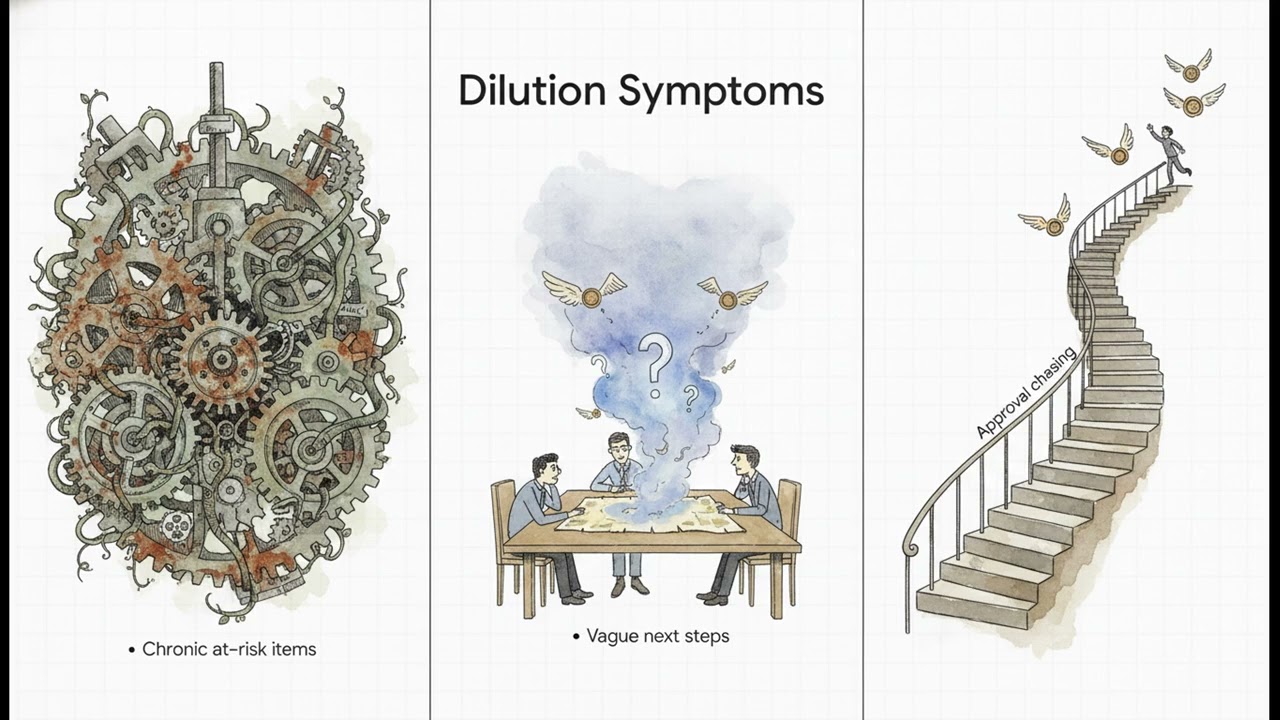
    Initiatives sit at risk without progressing, decisions reappear on successive agendas, and the same approval gets sought repeatedly from the same group. Where those three appear together, the governance structure is producing deferral rather than direction.

    Diagnose the constraint before adding process

    The reactive response to stalled technology decisions is procedural: a new steering committee, a formal intake process, an additional review board. Each addition feels like control and functions as delay. Composure matters more than speed at this point, because the wrong correction is difficult to reverse once it has been installed and staffed.

    The disciplined move is to stop and map where authority actually sits, which is rarely where the organization chart indicates. Consider the difference between a bottleneck and a constraint, since the two require opposite responses. A bottleneck is a point where flow narrows and can be widened with capacity. A constraint is a structural limit that no additional throughput resolves, and undefined decision rights are a constraint rather than a bottleneck.

    The enforcement gap

    Executive development frequently teaches leaders to optimize for influence rather than authority. Influence operates through persuasion, and persuasion makes compliance optional by construction. Where compliance is optional, directives function as suggestions, and delivery degrades in a way that presents as a culture problem while originating as a structural one.

    The causal chain is specific and repeatable across engagements. A leader is coached to prioritize comfort over authority, and the team correctly infers that instructions are negotiable. Execution slows, and the organization responds with further alignment work that reinforces the original condition. Technical staff read authority with particular accuracy, so where an owner cannot enforce a standard, that standard becomes advisory and parallel practice emerges to fill the vacuum.

    Ownership and approval are different instruments

    The systemic correction separates two roles that organizations routinely merge into one. This distinction is the operating framework, and it holds across vendor selection, architecture standards, and exception handling. Operational excellence in technology depends on it more than on tooling.

    Ownership is the non-transferable right to make the final call, and it is singular by definition. It carries the consequence, and it cannot be delegated to a group without ceasing to be ownership at all.

    Approval is a constraint check rather than a vote. It confirms that a decision sits inside defined boundaries such as budget, regulatory obligation, or security policy. The owner may proceed against an approver’s stated preference where no defined constraint has actually been breached. When approval acquires the force of a vote, every constraint holder becomes a veto holder, and the organization returns to consensus under a different name.

    Naming the framework that carries the structure

    The RACI model separates responsible, accountable, consulted, and informed roles, and its value in technology governance lies almost entirely in the second letter. Most implementations dilute the accountable role by assigning it to a committee, which reproduces the original problem inside a framework meant to solve it. The DACI variant, which names a single driver alongside the approver, holds up better under pressure because the driver role resists distribution by design.

    A decision rights matrix formalizes this across recurring decision classes rather than individual decisions. Engagements that install one report the same early effect. The volume of decisions reaching the executive calendar falls. Most of those decisions already had owners who did not know they held the authority.

    The matrix does not create authority. It makes existing authority legible, and legibility is what converts a chart into a system.

    Applying the structure to technology decisions

    For an organization running technology without a dedicated CIO, this governance layer determines outcomes more reliably than any technical assessment. Vendor commitments, tooling selection, security exceptions, and modernization sequencing all fail through the same mechanism. No individual holds the pen, so the decision routes to a committee that cannot carry consequence, and the calendar decides by default.

    The correction is procedural and inexpensive relative to what deferral costs. Name a single accountable owner for each recurring technology decision class rather than for each decision. Define what each approver is checking, explicitly and in writing, and limit them to that boundary. Set a decision deadline that expires into the owner’s judgment rather than into another meeting, because a decision right without a deadline is an invitation to defer.

    Decision rules to apply immediately

    Where a project has appeared in multiple consecutive meetings without measurable movement, remove all shared ownership language and assign one named owner with constraint-based approvals. Do this before adding any further process to the path.

    Where an approver cannot state which specific constraint they are checking, that person is a reviewer rather than a gate. Remove them from the approval path and give them visibility into the outcome instead.

    Where a technology standard is routinely bypassed, treat the bypass as evidence about the standard rather than about the people bypassing it. A standard that runs slower than the work will be routed around, and enforcement effort does not change that arithmetic.

    Governance is a cadence, not a document

    Decision rhythm is the containment structure for strategy. An organization that does not control the rhythm of its own decision making will be controlled by operational noise instead, and high meeting activity is not evidence of governance. It frequently indicates the absence of it.

    The practical form is unglamorous and consists of three elements. A standing decision forum runs on a fixed cadence. A visible register lists every open decision with an owner and a deadline attached. Anything still undecided at its deadline resolves to the named owner.

    This is process architecture rather than bureaucracy, and the difference is that each element shortens the path to a decision rather than extending it. Coherence compounds from there, because each decision made cleanly teaches the organization how the next one will be handled.

    Structure is what protects people

    The reason to install this is not administrative tidiness. Ambiguous authority is experienced by staff as personal risk, and it corrodes trust in the operating structure. People who do not know whether they may decide will escalate, wait, or build quiet workarounds. Each of those responses costs them something, and the cost is rarely visible to the leadership that created the ambiguity.

    Clear decision rights remove that exposure and protect human capital from avoidable strain. Servant leadership is expressed here as structure rather than as sentiment.

    A named owner knows the call belongs to them. An approver knows the single boundary they hold. Everyone else knows the matter is settled and can proceed.

    Structure is empathy at scale, and in technology governance it separates a team that ships from a team that hedges. Organizations that make this change consistently describe the same second-order effect, which is that technical staff begin surfacing problems earlier because raising one no longer carries ambiguous consequences.

    Accountability is an unnatural state for organizations. Groups drift toward shared ownership because shared ownership is comfortable, and that comfort is not a failure of character but a predictable response to unclear structure. Build the structure so the drift has nowhere to go.

    The organizations that govern technology well rarely hold the most sophisticated review process. They are the ones where a specific person can say yes on a specific Tuesday. Everyone already knows who that person is.

    Watch the full explainer

    https://youtu.be/kdwRFy1s9Q8

    Related

    Further material on operations, decision rights, and fractional executive leadership from Kamyar Shah: kamyarshah.com

    For an operational diagnosis of a specific situation, the free diagnostic is at businessconsultant.services
    → 7:14 AM, Aug 3
  • The first month of a fractional CMO engagement is not about campaigns. Companies that bring in a fractional CMO expecting new creative direction, a refreshed ad strategy, or a brand overhaul in the first 30 days have misidentified the problem.

    Month one is diagnostic. Here is what that looks like in practice.

    chiefoperatingofficer.substack.com/p/what-a-…

    → 10:29 AM, Jun 18
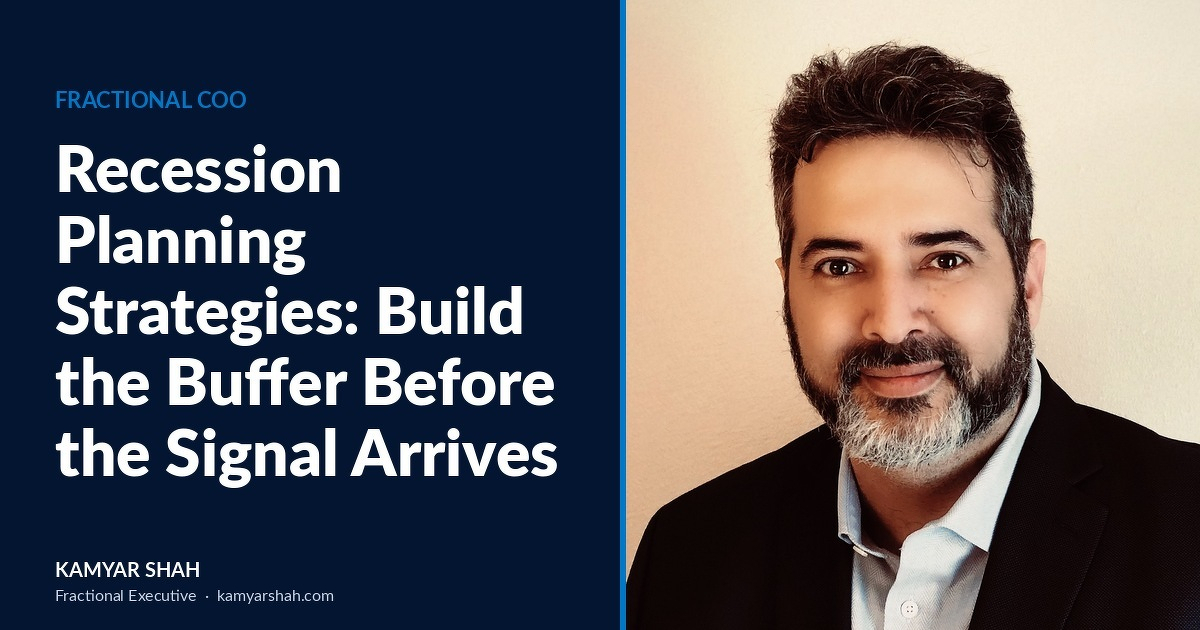
  • Recession Planning Strategies: Build the Buffer Before the Signal

    True recession planning isn’t about panic; it’s about optionality. Most businesses start planning when revenue drops, but by then, credit is tight, and margins are already thin. In Kamyar Shah’s latest guide, the focus is on building a buffer before the “official” signal arrives.

    Key strategies for resilience:

    1. Build Cash Reserves: Liquidity is your primary defense when credit markets freeze; secure financing while the sun is still shining.
    2. Shift to Variable Costs: Audit your cost structure and convert fixed costs to variable costs where possible to maintain agility.
    3. Strengthen Client Ties: Double down on your current customer base, as retention is significantly cheaper than acquisition during a downturn.
    4. Establish Credit Lines: Don’t wait until you need the money to ask for it; set up access to capital before lending criteria tighten.

    The goal is to align internal systems so you can emerge with a stronger market position while others are still reacting to the contraction.

    Read the full breakdown here: https://kamyarshah.com/recession-planning-strategies/

    #BusinessStrategy #Leadership #RecessionPlanning #FractionalCOO

    → 2:22 PM, May 13
  • Marketing Budget Optimization: Closing the Attribution Gap to Protect Your Bottom Line

    Marketing budget optimization is not about spending less; it is about ensuring that every dollar spent is tied to a measurable outcome. Without accurate tracking, businesses often misallocate funds to underperforming channels while starving their best growth drivers.

    In Kamyar Shah’s latest guide, the focus is on moving away from vanity metrics and toward a rigid, revenue-linked framework.

    Key optimization strategies:

    1. Close the Attribution Gap: Implement accurate channel tracking to understand exactly where your customers come from and which touchpoints drive the most value.
    2. Lead-to-Revenue Tracking: Stop measuring success by “leads” and start measuring by “qualified pipeline velocity” and closed-won deals.
    3. Eliminate Silos: Ensure your marketing technology stack communicates with your sales CRM to remove data blind spots.
    4. Strategic Reallocation: Regularly audit your spend to cut low-ROI activities and double down on initiatives that move the needle this quarter.

    The goal is to transform your marketing from a cost center into a predictable, scalable revenue engine.

    Read the full breakdown here: https://kamyarshah.com/marketing-budget-optimization/

    #MarketingStrategy #BudgetOptimization #BusinessGrowth #Leadership #KamyarShah

    → 2:21 PM, May 13
  • Operational Efficiency for Growth: Scaling Without Breaking Your Systems

    Scaling a business is not just about increasing revenue; it is about ensuring your operations can handle the weight of that growth. Without efficiency, expansion often leads to burnout and diminishing returns.

    In Kamyar Shah’s latest guide, the focus is on building a scalable foundation that supports sustainable growth.

    Key efficiency strategies:

    1. Process Optimization: Identify and eliminate bottlenecks that slow down production or service delivery.
    2. Technology Integration: Leverage automation and modern software to handle repetitive tasks and reduce manual errors.
    3. Resource Allocation: Ensure your team and capital are focused on high-impact activities rather than administrative overhead.
    4. Data-Driven Decisions: Use real-time operational metrics to pivot quickly and allocate resources where they are most effective.

    Efficiency is the bridge between a small, struggling business and a large, profitable enterprise.

    Read the full guide here: https://kamyarshah.com/operational-efficiency-for-growth/

    #OperationalEfficiency #BusinessGrowth #Scaling #Leadership #KamyarShah

    → 2:19 PM, May 13
  • COO vs. Director of Operations: Key Differences for Scaling Your Business

    Choosing between a COO and a Director of Operations is a critical decision for growing companies. While both roles focus on execution, the scope and strategic impact differ significantly.

    In Kamyar Shah’s latest analysis, the distinction is broken down to help leaders hire the right role for their current stage.

    Key distinctions:

    1. Strategic vs. Tactical: A COO is a strategic partner focused on long-term growth and vision, while a Director of Operations focuses on the day-to-day efficiency and tactical execution.
    2. Reporting Structure: The COO typically reports directly to the CEO and oversees the entire organization, whereas a Director of Operations often reports to the COO or CEO and manages specific departments.
    3. Decision-Making: COOs have high-level autonomy to pivot the company’s direction; Directors of Operations ensure the current systems are running at peak performance.
    4. Scale: Smaller companies often start with a Director of Operations to manage workflows, while a COO is brought in when the complexity of scaling requires executive-level leadership.

    Understanding these roles prevents hiring mistakes and ensures your leadership team is structured for success.

    Read the full breakdown here: https://kamyarshah.com/coo-vs-director-of-operations/

    #COO #Operations #BusinessGrowth #Leadership #KamyarShah

    → 2:17 PM, May 13
  • Operational Resilience Strategies: Building a Business That Can Absorb Shocks

    Operational resilience is about more than just surviving a crisis; it is about building a business that can absorb shocks and keep moving.

    In Kamyar Shah’s latest guide, the focus shifts from reactive fixes to proactive structural strength.

    Key strategies for resilience:

    1. Redundancy: Identify single points of failure in your supply chain and talent pool.
    2. Agility: Create decentralized decision-making processes to move faster during disruptions.
    3. Tech Debt: Audit your infrastructure to ensure legacy systems don’t become your biggest liability.
    4. Stress Testing: Regularly simulate disruptions to find where the cracks appear before they become real.

    Resilience is a competitive advantage that becomes visible only when things go wrong.

    Read the full strategy here: https://kamyarshah.com/operational-resilience-strategies/

    #BusinessOperations #Resilience #Leadership #KamyarShah

    → 2:14 PM, May 13
← Newer Posts Page 16 of 24 Older Posts →
  • RSS
  • JSON Feed
  • Surprise me!