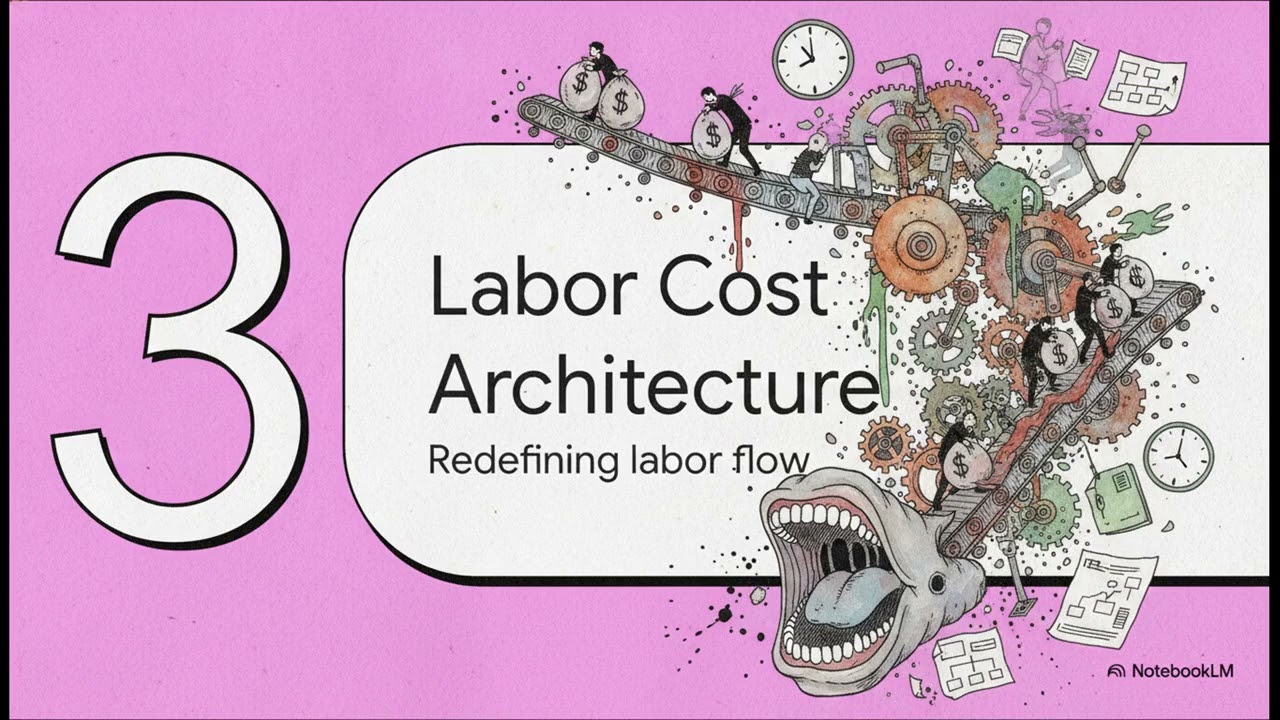
When margin tightens, the reflex is to reduce headcount. Structurally that sequence is inverted. Cutting people without first auditing the process architecture removes capacity while leaving the work in place. The work then reappears somewhere less visible and more expensive.
Two kinds of labor sit inside the same payroll line
Value-producing labor generates output. It is the work that would still exist if every system in the organization functioned perfectly. Most cost analysis treats the entire payroll as this category, which is where the error begins.
Compensating labor exists only to bridge gaps where protocols should be. Someone moves data between systems that do not talk to each other. Someone chases an approval that was never formally defined, or rebuilds a report because the source of record is ambiguous.
None of that work produces output. All of it is indistinguishable from real work on a headcount line, which is why it survives every review that starts from the payroll rather than from the process.
Compensating labor is a symptom of missing structure rather than a category of role. Removing it without repairing the structure relocates the work rather than eliminating it. The relocation is usually to someone more senior and more expensive.
Why the headcount reflex fails structurally
Reducing headcount treats a symptom and leaves the mechanism intact. The ability to execute reliably depends on the system underneath the people. Organizations that never build an operating system to replace direct founder oversight push all that coordination back onto individuals by default.
The failure runs in a predictable sequence. Protocols are absent, so people compensate manually, and manual compensation consumes senior attention because escalation is the only available resolution path.
The executive calendar then fills with internal coordination rather than external growth. Growth slows, margin tightens further, and the reflex fires again.
Each cycle removes capacity while leaving the generating mechanism untouched. This is why cost reduction programs frequently produce a second cost reduction program eighteen months later. The first one addressed the expression rather than the cause.
Task decomposition comes before any cut
The corrective work starts with mapping rather than with a target number. Every recurring task gets sorted into value-producing and compensating categories. This is slow, and rushing it undermines everything downstream, because the entire subsequent decision depends on the accuracy of the split.
Two rules make the sort reliable and repeatable. Ask what the task would look like if every adjacent system worked correctly, since compensating work disappears entirely under that condition. Then follow the task backward to the gap it exists to bridge. Compensating work always has a specific structural origin, and rigor in tracing it is what separates a real audit from a guess.
The output is not a list of people. It is a list of structural gaps with the labor cost of each attached. That inversion is what converts a cost conversation into an operations conversation.
Process assignment turns the map into action
Where compensating labor exists because decision rules were never documented, the correction is documentation rather than headcount change. Writing down who decides what, and under which conditions, removes the escalation traffic that consumed the time. This is the cheapest intervention available and it is routinely skipped because it produces no visible artifact.
Where ambiguity between departments generates constant clarification, the correction is handoff protocol definition. A handoff protocol specifies what moves, in what state, to whom, and what constitutes acceptance. Most interdepartmental friction resolves once acceptance criteria exist, because the friction was never disagreement but undefined completion.
Where the compensating work bridges two systems that do not integrate, the correction is either integration or a documented manual protocol with a named owner. Leaving it undefined guarantees the work continues invisibly and gets attributed to someone’s workload rather than to the gap.
Naming the frameworks that make the split legible
Lean methodology draws exactly this distinction and calls the second category waste, specifically the waiting, motion, and defect categories that describe compensating work with precision. The value of naming it that way is that it moves the conversation off people and onto the process that produces the work.
Activity-based costing supplies the other half. Conventional cost accounting assigns expense to departments. Activity-based costing assigns it to the activity consuming the resource, which makes compensating labor visible as a line rather than as an assumption. The two together turn an opaque payroll figure into an itemized structural bill.
A simple value stream map is usually enough to start. Following one recurring output from request to delivery and marking every wait, handoff, and rework loop exposes more compensating labor in an afternoon than a quarter of budget review. Consistency in how the map is drawn matters more than sophistication in the tooling.
Where alignment does the financial work
Cost structure and strategic fit are the same conversation held in different vocabulary. A cost base aligned to what the organization actually does is smaller than one carrying the residue of what it used to do. Most cost bases carry more residue than anyone has measured.
Shared understanding of which activities are differentiating is the precondition for that alignment. Where finance, operations, and delivery hold different answers to that question, the organization funds all three interpretations simultaneously. Coherence between those views is worth more than any single reduction target, because it determines which reductions are even the right candidates.
Continuity matters here too. A cost base corrected once and left unmonitored drifts back, since the structural gaps that generated compensating labor regenerate it as soon as attention moves. Calm, periodic re-examination holds the gain better than an aggressive one-time programme.
Choosing the right kind of external help
Once structural gaps are visible, buying the wrong kind of external help wastes capital efficiently. The distinction that matters is between analysis and installation, and it is frequently blurred during the purchase.
An adviser who delivers analysis produces a document and a set of recommendations. That is useful where the constraint is knowledge, meaning the organization does not know what to do. An operator who builds execution infrastructure produces a functioning system. That is required where the constraint is capacity, meaning the organization knows what to do and has nobody with the authority and time to install it.
Confusing the two guarantees mismatched expectations on both sides. The resulting disappointment gets attributed to the individual rather than to the category error that produced it, which means the same mistake gets repeated with a different name.
Conditional rules for capital allocation
Each of the following is a diagnostic rather than a preference, and each maps a specific constraint to a specific intervention.
Where decisions have no owner and no rhythm, the intervention is structural rather than advisory. Coaching an individual will not install a decision cadence, and a strategy document will not name owners.
Where the constraint is individual leadership patterns rather than organizational structure, executive coaching addresses it and process work will not. These two look similar from the outside and respond to opposite treatments. Steadiness in telling them apart saves more capital than speed in choosing between them.
Where necessary work sits outside the organization’s core competency, outsourcing is more direct than internal capability building. Building durable internal capability for work that will never differentiate the business is a slow way to spend money. Where the work is differentiating, the reverse holds and outsourcing it exports the advantage.
Red flags that the diagnosis was wrong
Where an intervention has been running for a full cycle and the underlying friction has not moved, the problem architecture was misidentified at the start. The common response is to fund the same intervention harder, which compounds the original error rather than correcting it.
A second flag is displacement. Costs fall in the measured category and rise in an unmeasured one, which indicates the work was relocated rather than eliminated. This is the signature outcome of cutting compensating labor without repairing the gap, and it is invisible to any report scoped to the original category.
A third flag is the return of the same conversation. Where a cost reduction discussion recurs on a predictable interval, the organization is treating a structural condition as a periodic event. The interval itself is the diagnostic.
Cost discipline protects people rather than pressuring them
The argument for this approach is not only financial. Compensating labor is experienced by the people performing it as low-value work that nobody acknowledges, because it produces no output anyone can point to. That erodes human capital quietly and steadily.
Removing the structural gap removes that work, which is materially different from removing the person doing it. Servant leadership expressed in operational terms means fixing the system that generates meaningless work rather than asking people to absorb it with better attitude. Trust in an organization tracks whether difficult decisions are made on structure or on convenience.
Teams distinguish between a company that cuts cost and a company that removes waste, and the distinction shows up in what happens to the survivors' workload. Where the work remains and the people do not, the message is unambiguous.
The question worth asking instead
The useful question is not how much can be cut, because that framing assumes the current cost base is a single undifferentiated quantity. It is not, and treating it as one guarantees the wrong reduction.
The useful question is how much of the current cost base exists only to compensate for structure that was never built. That figure is knowable, it is usually larger than expected, and it can be removed without removing capacity. Answering it requires the decomposition work that cost pressure makes everyone want to skip.
Cost discipline compounds the same way operational discipline does. Each structural gap closed removes its associated labor permanently rather than for one budget cycle, and the accumulated effect is a cost base that does not require periodic emergency correction.
Watch the full explainer
Related
Further material on operations and fractional executive leadership from Kamyar Shah: kamyarshah.com
For an operational diagnosis of a specific situation, the free diagnostic is at businessconsultant.services