Most operational bottlenecks get diagnosed as capacity or tooling problems and treated by adding one or the other. Where the constraint is structural rather than technical, adding capacity makes the condition worse. Every additional person increases coordination load faster than it increases productive output.
Headcount scaling and operational scaling are different actions
Headcount scaling manages friction. More people absorb more of the same overhead, and the underlying system continues generating it at the same rate. The friction is not reduced, only distributed across a larger payroll, which is why the relief from a hiring round tends to fade within two quarters.
Operational scaling changes the system so that the friction stops being produced at all. The existing team then delivers disproportionately more without any addition to headcount. Organizations reliably attempt the first when the situation calls for the second, because hiring is visible and system repair is not. Diagnose which one the constraint actually requires before approving either.
Coordination collapse
Early stage organizations run on informal proximity, and they run on it well. Everyone holds roughly the same context because everyone sits close enough to absorb it without a documented process. This works genuinely rather than accidentally, and its success is precisely what makes the eventual failure surprising to the people inside it.
Coordination collapse is the point where organizational complexity outpaces that mechanism. One team now holds context another team lacks, so work that used to move on assumption requires explicit negotiation. The symptom presents as a communication breakdown. The cause is structural growth past the range where proximity worked.
Treating the symptom produces more meetings. Treating the cause produces documented context that does not depend on who happens to be in the room. Operational excellence at this stage is mostly the discipline to write things down before the calendar absorbs the alternative. Build the second before the first consumes the week.
Decision latency
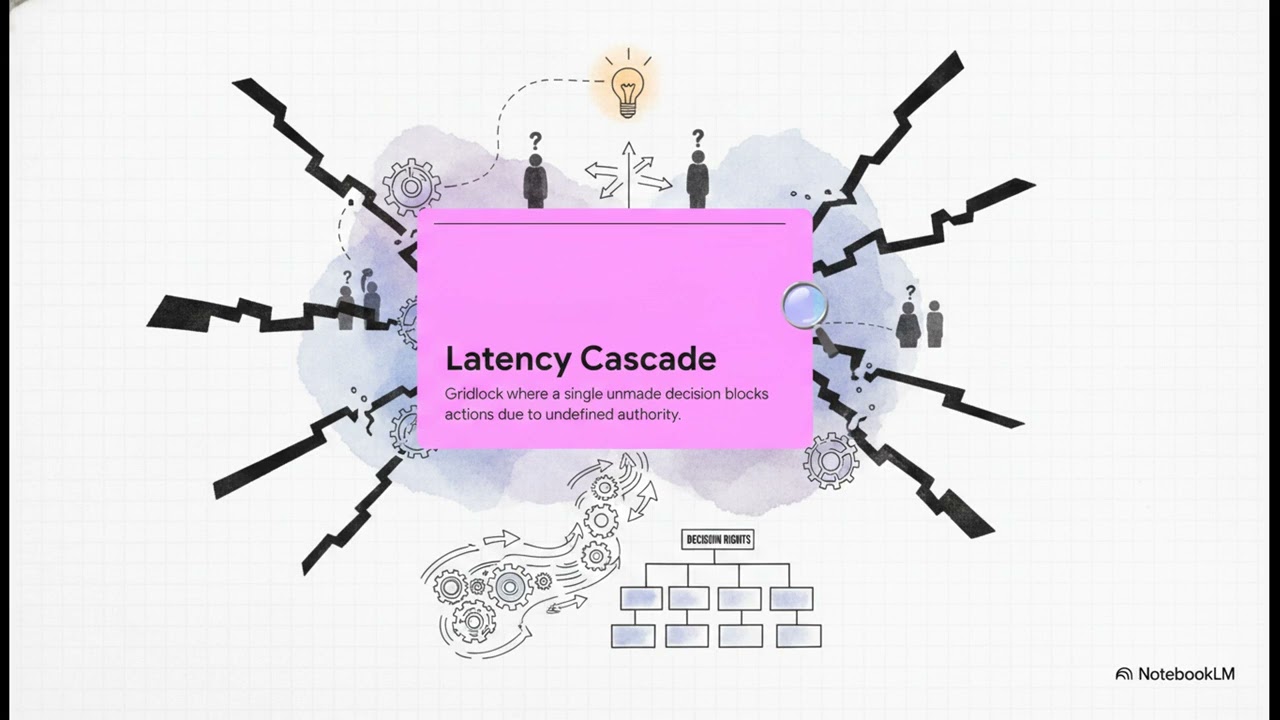
A second failure mode appears where decision rights were never defined. A single unmade decision blocks a long chain of dependent work. Because nobody is certain they hold the authority, routine decisions escalate upward by default.
Without a documented operating rhythm that forces choices on a schedule, delay becomes the resting state. Leadership then experiences its calendar filling with decisions that should never have reached that level. The escalation is not a discipline failure. It is a rational response to unclear authority, and it will continue until the authority is made explicit.
Decision latency compounds differently from other operational drag, and the difference matters for triage. Capacity problems slow work proportionally, so doubling the load roughly doubles the delay. Latency problems stop work entirely until the decision arrives, regardless of how much capacity sits idle behind the block. Treat latency as the higher priority, because it wastes capacity that has already been paid for.
The premature automation trap
This is the most expensive version of the mistake in a technology context. Software gets deployed on top of a process nobody has examined. The purchase feels like progress because it is concrete, dated, and easy to report.
Automating a wasteful process does not remove the waste. It produces that waste faster and more consistently, and now carries a licence cost alongside it. Diagnosis has to precede prescription, and composure at that moment is worth more than speed.
A related failure runs quieter and lasts longer. Where the strategic process requires one outcome and the daily workflow is sequenced for a different one, the organization generates continuous drag that nobody can locate. No tool resolves this, because the tool is faithfully executing the wrong sequence. Strategic fit between intent and workflow is checked far less often than either is checked alone, and the gap between them is where most operational cost hides.
The improvement sequence that holds
Lean methodology and Six Sigma disagree about a great deal, and they agree about order. Both require that waste be identified before it is engineered against, and both treat measurement as a precondition rather than a reporting exercise. The Theory of Constraints goes further and argues that improving anything other than the binding constraint produces no throughput gain at all. That shared premise is the part worth carrying into any operations decision.
Uncover the hidden drag forces first, which usually means watching the work rather than reading the process document. Define the improvement target second, in observable terms. Redesign the process structurally to eliminate what was found, third. Only then consider tooling.
Reversing this order produces the common outcome: a modern system performing an obsolete process, and an organization concluding that the system failed. The system did not fail. It was installed at the wrong point in the sequence.
Conditional rules for choosing the intervention
Match the intervention to the actual constraint rather than to the most available solution. Each of the following is a diagnostic, not a preference.
Where variation in how a necessary task gets performed is the problem, standardize the output before automating anything. Six Sigma logic applies when the defect is inconsistency rather than speed. Where tasks generate friction but sit outside the organization’s core competency, structured outsourcing addresses it more directly than internal process work. Building internal capability for work that will never be differentiating is a slow and quiet way to spend money.
Where the environment is uncertain and the correct sequence is not yet known, standardization is premature and will lock in a guess. Locking in a guess costs more than tolerating variation for another quarter, because the guess acquires defenders once it has been documented. Wait for the pattern to stabilize, then standardize what the work has already proven. Consistency of judgment here compounds.
What operational coherence actually looks like
Coherence is the condition where the strategic intent, the documented process, and the daily behavior all describe the same activity. Most organizations hold all three and no alignment between them, which is why process documentation so often surprises the people it supposedly describes. The gap is not dishonesty. It is drift that nobody was assigned to notice.
The test is inexpensive. Ask three people at different levels to describe how a specific recurring decision gets made. Where the answers diverge, the process document is fiction and the real process lives in individual habit. That divergence is the operational debt, and it accrues interest in the form of coordination time.
Systems exist to make behavior repeatable without supervision. A process that only functions when a specific person is watching is a dependency wearing a system’s paperwork. That distinction determines whether the organization can grow past its most senior operator. Remove that participant on paper and ask what happens next.
Where the constraint usually sits in a technology function
Technology operations concentrate their constraints in three places, and the distribution is consistent enough to be worth checking in order. Working through them in order usually locates the binding one. Skipping the sequence applies effort where it changes nothing.
The first is approval depth, meaning the number of separate consents required before work can start. Each consent adds latency rather than capacity. Count the consents on a recent piece of work and compare that number to its actual risk.
The second is context ownership, meaning whether the person who understands a system is the same person authorized to change it. Where those separate, every change requires a translation step, and translation steps lose information reliably. Reunite them where possible and document the interface where not.
The third is queue discipline, meaning whether incoming work is prioritized by a rule or by whoever asked most recently. Absent an explicit rule, urgency substitutes for importance. Install the rule before adding people to the queue.
Measure the system, not the effort
Most operational reporting measures activity because activity is easy to count. Tickets closed, deployments shipped, meetings held. None of those indicate whether the system underneath is improving or degrading, and a team can raise all three while the operation gets worse. Activity metrics answer whether people are busy, which was rarely the open question.
The measures that matter are structural. Time from request to decision exposes latency, proportion of work requiring escalation exposes unclear authority, and rework rate exposes ambiguous handoffs. Each describes the system rather than the people operating it. Each moves when the structure changes rather than when the team works harder.
Balanced Scorecard logic applies in its original sense, which is that a single measure invites gaming while a small balanced set does not. Pick three structural measures and hold them stable long enough to see a trend.
Structure protects the people inside it
The argument for fixing this is not efficiency alone. Ambiguous process is absorbed by staff as personal risk, and human capital erodes under sustained ambiguity faster than under sustained workload. People tolerate a heavy quarter. They do not indefinitely tolerate not knowing whether their judgment will be supported.
People who do not know how a decision gets made will either escalate it, wait for it, or work around it. Each response costs them time and standing, and none of the three is visible on a report. Servant leadership expressed operationally means removing that ambiguity rather than encouraging people to tolerate it.
Trust follows structure more reliably than structure follows trust. Teams extend confidence to a system that behaves predictably, and predictability is a design output rather than a cultural aspiration. Culture work on a structural problem produces goodwill that decays at the next ambiguous decision. Fix the structure and the culture question answers itself.
Fix the system before the crisis forces the choice
Waiting until informal proximity collapses entirely, or until decision latency cascades into visible failure, means the restructuring happens under crisis conditions. Crisis restructuring is more expensive and produces worse decisions, because the same coordination capacity that failed is now being asked to redesign itself.
The disciplined version is unglamorous. Map where context actually lives, then name who decides what. Install a rhythm that forces those decisions on a schedule rather than on escalation. Each element compounds, and the accumulation is what people later describe as a well run operation.
The question worth putting to any growing organization is narrow. It is not whether the team is working hard enough, because it almost always is. It is whether the organization is adding capacity to a system that consumes it. The alternative is repairing the system and releasing the capacity already locked inside the friction.
Watch the full explainer
Related
Further material on operations and fractional executive leadership from Kamyar Shah: kamyarshah.com
For an operational diagnosis of a specific situation, the free diagnostic is at businessconsultant.services