Chief Operating Officer
About Fractional COO: Strategic Leadership and Operational Scaling Operations Management: Systems and Processes for Scalable Growth Search Feeds Also on Micro.blog
  • Strategy Consulting and Business Consulting Answer Two Different Questions

    Strategy Consulting vs Business Consulting - Kamyar Shah, Fractional COO

    Strategy consulting answers where a company should compete. Business consulting answers how it should operate. The two disciplines use different methods, produce different deliverables, and are worth different amounts depending on which question is actually open. Naming the question correctly is most of the selection decision, and getting it wrong costs a full engagement cycle.

    Two Disciplines, Two Questions, One Common Confusion

    The terms are used interchangeably in the market because both arrive as an outside adviser with a diagnostic posture. Underneath, one changes the destination and the other changes the vehicle. Buyers rarely hear the difference in a sales conversation, since both parties use the same vocabulary of growth and improvement.

    A company that buys the wrong one receives competent work aimed at a question it was not asking. That failure is invisible during the engagement, because the deliverable is good even when the relevance is not. Nobody in the room has cause to object. Define the open question in a single written sentence before contacting anyone.

    Direction Work Sets the Boundary Conditions

    Positioning decisions determine which customers the company serves, how it differentiates, and what it declines to pursue. Porter framed this as a choice between cost leadership and differentiation, and the choice matters mainly because it tells the organization what to refuse. Those decisions set the boundaries inside which every operating decision is later made. A well-run process aimed at the wrong customer is still the wrong process.

    Companies between five and fifty million dollars in revenue often carry positioning that was set informally at a much smaller size and never revisited. The market changed, the offering broadened, and the stated position stayed where it was. Revisit the boundaries before optimizing anything inside them.

    Growth Vectors Are Choices, Not Aspirations

    Ansoff’s framework separates growth into four distinct vectors: deeper penetration of current markets, new markets with current offerings, new offerings for current markets, and diversification into both. Each vector demands different capabilities, different capital, and a different tolerance for time.

    Naming a growth target without naming the vector produces effort spread evenly across all four, which is the most expensive way to pursue any of them. Sales enters new segments while product extends the line and neither is resourced to succeed. Choose the vector explicitly, then resource it to the exclusion of the others.

    Capital Allocation Is the Decision Most Often Made Intuitively

    Capital in a mid-market company includes cash, leadership attention, and the capacity of a small number of capable people. Most owners allocate all three by instinct and recent pressure rather than by expected return.

    The discipline that pays here is zero-based budgeting, where every request is tested against the next best use of the same money rather than against zero. Structured analysis produces its largest returns at this stage precisely because the baseline is intuition rather than rigor. Companies that write the reasoning down consistently report that half the contested items withdraw themselves. Make allocation an explicit quarterly decision with written reasoning attached.

    Ownership Transitions Need a Long Runway

    Preparing a company for acquisition, recapitalization, or a leadership handover is strategic work that begins eighteen to thirty-six months ahead of the event. Companies that start when a buyer appears negotiate from whatever condition they happen to be in.

    The preparation window is where positioning, revenue concentration, and management depth can still be changed at reasonable cost. Once a process is live, those become disclosures rather than choices. Start the work while no transaction is pending.

    Operating Work Builds the Machinery Direction Requires

    Process design, organizational structure, systems selection, and capability building all sit downstream of a chosen direction. This is the discipline that decides whether a stated strategy is reachable with the people and tools presently in the building.

    Operating questions are answerable, measurable, and comparatively fast, which is why they attract attention even when they are not the constraint. That accessibility is a trap when direction is unresolved. Engage this discipline once the destination is settled.

    Structure and Systems Are Expressions of the Strategy

    Reporting lines, role definitions, decision rights, and performance measures are the physical form a strategy takes. A structure built for fifteen people will not carry a plan written for eighty, regardless of how capable those fifteen are. Structural mismatch usually presents as personality conflict, which is why it is so often misdiagnosed.

    Systems selection follows the same logic and is usually discussed as a software question when it is a question about what information reaches which decision. An organization that cannot see margin by service line will allocate capital badly no matter how sound its judgment. Specify the decisions first, then select the platform and the structure that serve them.

    The Diagnostic Question That Routes the Engagement

    Ask whether the company is stuck because it does not know where to go, or because it cannot reach a destination it has already chosen. Disagreement in the leadership team about what to do next indicates a direction question.

    Consistent misses against agreed targets, despite steady demand, indicate an operating question. The two conditions feel similar from inside the company, since both present as frustration and missed plans. Answer the diagnostic honestly, because it determines which discipline is worth paying for.

    Misrouting Produces Precision Aimed at the Wrong Target

    Buying operational improvement while the direction is unresolved makes the organization more efficient at pursuing something it has not chosen. Buying strategic direction while execution is unreliable produces a well-reasoned plan the organization cannot carry.

    Both engagements can be executed to a high standard and still return nothing, which is what makes the error so difficult to detect afterward. Post-mortems blame the adviser when the fault sat in the routing. Route the question before scoping the work.

    The Ambiguous Case Is the Common One

    Many companies arrive with a loose sense of direction and an operating foundation weak enough that any plan would be difficult to run. These organizations frequently cycle through advisers, buying direction and execution in alternating years from sources that never speak to each other.

    The cycling itself is the diagnostic signal, and it is more reliable than anything the leadership team reports about its own condition. Two engagements that each half-worked point at a routing problem. Treat both questions as open and sequence them under a single owner.

    Deliberate and Emergent Strategy Are Both Real

    Mintzberg observed that realized strategy is part deliberate intention and part pattern that emerged from decisions made along the way. A plan fixed at the start of a year and reviewed only at the end suppresses the emergent half entirely.

    Strategy and operations are iterative rather than sequential, which is why quarterly review outperforms annual planning at this size. A Balanced Scorecard structure gives the review something to read against, covering financial, customer, internal process, and learning measures together. Organizations that hold the review on a fixed date describe the plan as something they adjust rather than something they defend. Schedule the cadence at the moment the plan is written.

    Select on Stage, Not on Reputation

    Advisory patterns that create growth at five hundred million dollars in revenue do not transfer cleanly to fifteen million. The larger company has specialists, reporting infrastructure, and a tolerance for long payback periods that the smaller one does not. Both bodies of experience are legitimate, and they are not interchangeable.

    The relevant question is whether the adviser has worked inside companies at the current stage with the current constraints, including the absence of specialist functions. Logos indicate access rather than fit. Ask for references at a comparable size and speak to them directly.

    Decision-Oriented Deliverables Are the Only Useful Output

    The product of any engagement should be a set of decisions with named owners, dates, and measures. When the primary artifact is a document, the engagement was structured for the adviser’s convenience rather than the organization’s outcome. A report closes cleanly, and a decision has to be defended.

    Documents record thinking, and decisions change operations. The distinction is easy to write into a scope and rarely is. Specify the deliverable as a decision set in the agreement, and name who signs each one.

    Routing the Question to the Right Discipline

    If the leadership team disagrees about where the company is going, buy direction work. When the direction is agreed and results still miss, buy operating work. Where revenue has plateaued while the team executes reliably, the constraint is positioning rather than performance.

    A fourth case covers most of the difficult ones. Both questions can be open at the same time, and the correct response is to sequence direction first and hold the operating work until the boundaries exist. Buying both at once from two sources reproduces the gap the engagements were meant to close.

    One Owner for Both Questions

    The traditional model separates the disciplines across two firms and two engagements, and the value lost between them is substantial. The second adviser interprets the first one’s recommendations and adapts them to what the organization can carry, which is a translation nobody was paid to get right.

    A fractional executive holds both questions at once, adjusting the direction as execution reveals what the organization can absorb. Companies that consolidate both under one accountable source report fewer abandoned plans and shorter recovery after a missed quarter. That continuity is what makes a plan survive contact with the operating calendar, and it is what earns the team’s trust in the plan. Prefer a single source when both questions are open.

    A Plan Is Only as Humane as Its Delivery System

    A strategy nobody can execute is experienced by staff as a sequence of impossible targets and a slow loss of confidence. The plan is not read as ambition. It is read as evidence that leadership does not understand the work.

    Aligning the plan to the structure, the systems, and the available capability is what makes ambition legitimate rather than punishing. Teams that see the plan matched to the resources describe targets as demanding instead of arbitrary. Shared direction and reliable process protect people from carrying the organization’s uncertainty personally. Build both, because a plan is only as humane as the system meant to deliver it.

    Direction and operation are not two purchases in sequence. They are two views of the same organization taken from different distances. Every plan a company writes teaches its people what leadership believes is possible. Companies that hold both views at once adjust continuously, and that continuity, accumulated quarter by quarter, is what growth is actually made of.

    Related

    For where the scope and the deliverables actually diverge, see strategy consulting vs business consulting.

    → 2:21 PM, Aug 5
  • An Interim COO Is Coverage, and Coverage Is a Knowledge Transfer Problem

    How to Hire an Interim COO - Kamyar Shah, Fractional COO

    An interim chief operating officer is a fixed-term executive brought in to stabilize operations and document what was never written down. Engagements run three to six months and close on a defined date. The work is neither advisory nor transformation. It is the recovery of operating knowledge before that knowledge leaves the building.

    Coverage and Construction Are Different Products

    Interim work stops an active loss, and fractional work builds capacity that compounds over years. The monthly rates are similar, which is why the two are so often confused, but the engagement shapes differ entirely. One is full-time attention across a short window, and the other is part-time attention across a long one. Only the second is designed to produce continuity.

    Confusing the two produces predictable disappointment in both directions. A company that buys coverage and expects transformation will judge a successful engagement as thin. An organization that buys construction during an active crisis will find the pace intolerable. Name which product is being purchased before negotiating the rate.

    The Trigger Is an Event, Not a Condition

    Interim coverage answers a dated occurrence: a departure, a merger, a funding round that forces a hiring wave, or a diligence process that exposed undocumented operations. Each has a beginning, a peak, and an end. That shape is what makes a fixed term appropriate.

    Conditions that recur without a triggering event are structural and will outlast any temporary engagement. A company that has replaced its operations leader three times in four years does not have a vacancy problem. Check whether the gap has a date attached, because that single test routes the decision correctly.

    What Actually Leaves With a Departing Operations Executive

    The organization chart shows one vacancy. The operating reality is that vendor relationships, approval judgment, escalation paths, and the reasons behind a dozen process exceptions leave in the same week. Teams keep working, but every decision that used to take an hour begins taking three days.

    The loss is rarely visible in the first month, because momentum carries the existing work through. It appears in the second month as a queue of small unresolved questions that nobody feels authorized to close. Inventory what the departing role decided, not what it managed.

    Tacit Knowledge Is the Asset at Risk

    Nonaka drew the distinction between explicit knowledge, which is written and transferable, and tacit knowledge, which lives in practice and judgment. Operating leadership runs heavily on the tacit form. Tacit knowledge does not appear in any handover file, because nobody thinks to write down what feels obvious.

    Converting it is the central task of an interim engagement, and conversion requires a person asking structured questions while the knowledge is still reachable. Exit interviews do not accomplish this, since they are scheduled after the departure decision and framed around sentiment. Schedule the conversion as work with a deliverable attached.

    Map the Value Chain as Practiced

    The first structural artifact is a model of how work actually moves, built from observation rather than from the documentation the company believes it follows. Orders enter somewhere, get approved by someone, and stall in a place nobody has named.

    Practiced flow and documented flow diverge most at exactly the points that cause delay, which is what makes the comparison useful rather than academic. The divergence is also where undocumented judgment is concentrated. Map what happens, then set it beside what was supposed to happen.

    Count the Single Points of Failure First

    Any step that depends on one person’s memory is a failure waiting on a calendar. Counting those steps produces a ranked list far more useful than a general assessment of operational health. The exercise takes an afternoon and reframes the entire engagement around a finite set of dependencies.

    The count is also the clearest number to report to a board, because it converts a vague concern into a finite list with accountable owners. Boards that receive the count instead of a narrative consistently report shorter meetings and faster approvals. Rank the list by how much revenue flows through each dependency.

    The First Ten Days Are Diagnostic

    The interim executive interviews department leads, reviews ninety days of operating and financial data, and maps the top recurring processes. The output is a two-page memo separating immediate risks, structural gaps, and quick wins.

    Length signals effort while brevity signals judgment, and a company in an operational crisis has no capacity to read forty pages. The memo should be readable in one sitting by a board member with no operating context. Deliver it on day ten and let it set the sequence for everything after.

    Days Eleven to Twenty Are Triage

    Three to five small process changes are implemented in this window, chosen because they restore movement rather than because they are ambitious. Their function is partly evidential. A team that has been stuck learns within two weeks that change is possible and that the new executive can execute.

    Momentum is a real input to everything that follows, because the harder structural work requires cooperation that has to be earned first. Selecting a difficult change here trades credibility for scope and usually loses both. Pick the changes that produce visible relief fastest.

    Days Twenty-One to Thirty Produce the Roadmap

    The thirty-day deliverable is a ninety-day stabilization framework naming the processes to document, the owner of each, the deadline, and the measure of completion. It also names who inherits each process after the engagement closes and what training that handoff requires.

    A roadmap without named successors is a report rather than a plan. Every item should sit with an accountable person who will still be present next year, which is a constraint that changes what goes on the list. Teams that see their own names against the work describe the handover as shared rather than imposed. Assign the owners before finalizing the scope.

    Approval Thresholds Are the Cheapest Structural Fix

    A large share of operational delay traces to approval workflows that route every transaction to one signature regardless of size. A tiered threshold model, where routine amounts clear at the department level and only material ones escalate, restores cycle time within days and costs nothing to implement.

    The change is small and the recovered velocity is not, which makes it an unusually good first move. Companies that publish tiered thresholds in the first month describe approval queues clearing before any headcount changes. Set the thresholds early, because the result funds credibility for the harder work.

    Evaluate on Documentation Discipline, Not Experience Alone

    Ask a candidate to show prior work product: a gap analysis, a stabilization plan, or a documented process from an earlier engagement. Documentation discipline is the single best predictor of what survives the engagement, and an executive who cannot produce artifacts manages people well while leaving nothing behind.

    Documented processes are valuable, rare, difficult to imitate, and organizationally embedded, which is the definition of a durable asset under the VRIO test. An interim engagement that produces no such asset has bought only attendance. Score the artifacts before scoring the biography.

    Exit Design Separates an Operator From a Placeholder

    The strongest interim executives describe their exit in the first conversation: what transfers, to whom, and what condition signals completion. Vague answers about staying as long as needed indicate an engagement optimized for duration rather than outcome.

    An interim role that becomes indefinite has quietly converted into an expensive permanent hire without the accountability of one. That drift is common and rarely noticed until a budget review. Require the exit criteria in writing before signing.

    Contract Structure Should Match the Nature of the Work

    Crisis coverage is continuous rather than milestone-shaped, so monthly billing fits it and milestone billing does not. A thirty-day termination clause protects both parties when the diagnosis changes what the engagement should cover.

    Rates in the range of eight to fifteen thousand dollars per month reflect fixed-term senior attention rather than project delivery. Structure the agreement around coverage, and schedule a formal scope revisit at day thirty once the diagnostic memo exists.

    Temporary Gap or Structural Gap

    If the gap was created by a single dated event and a permanent hire is achievable within six months, use interim coverage as a bridge. When the organization has cycled through several operations leaders in a few years, the gap is structural and another temporary executive will reproduce the pattern.

    Where the founder remains the decision routing layer, the constraint is the operating model rather than the vacancy, and no hire at any level will resolve it. Both an event and a structural condition are frequently present at once. Cover the event first and schedule the structural work behind it.

    Coverage Buys Time, and Time Has to Be Spent

    An interim engagement is best understood as purchased time, and time is only valuable if something is built during it. Companies that treat coverage as a holding action return to the same condition the week the engagement ends.

    Companies that treat it as a documentation window emerge with an operating system they did not previously have. Those companies consistently report that the next transition costs a fraction of the first. The price of the two approaches is identical. Decide which one is being bought before the engagement starts.

    What the Team Needs While the Search Runs

    Transitions are experienced by staff as uncertainty about who decides and what happens if they are wrong. Written procedures, published approval thresholds, and named owners protect the team from that uncertainty faster than any reassurance from leadership. Clarity travels further than encouragement during a disruption.

    The documentation an interim executive produces is a form of care as much as a form of control. It tells people what is expected of them while the organization is unsettled. Build it early, since the team is carrying the disruption while the search continues.

    Every operating role eventually ends, planned or otherwise, and the only question is whether the knowledge stays. An organization that documents while it is calm never needs coverage. One that documents only under pressure will pay for the same knowledge twice, which is the argument for writing things down long before anyone gives notice.

    Related

    Evaluation criteria, engagement structure, and the five scenarios that justify coverage are laid out in how to hire an interim COO.

    → 2:21 PM, Aug 5
  • Delegation Fails at the Handoff, Not at the Person

    Strategic Delegation for Founders - Kamyar Shah, Fractional COO

    Founders describe failed delegation as a people problem, and it is almost never one. Work comes back wrong because the handoff carried no definition of done, no authority level, and no escalation path. Trust in a person and trust in a process are separate variables. Repair the weaker one instead of reclaiming the task.

    The Founder Bottleneck Is a Design Outcome

    Every founder who still approves routine decisions built a company that requires those approvals. The structure was never chosen deliberately. It accumulated one exception at a time until the founder became the routing layer for work nobody else was authorized to complete.

    That is a design condition, and design conditions are correctable. Reading it as a comment on the team produces hiring changes that do not alter the routing at all. The replacement inherits the same missing authority and the same undefined standard. Treat the bottleneck as an artifact of the operating model.

    The Reflex That Feels Efficient Compounds Into Dependency

    Doing the work personally is faster once and slower forever. Each time a founder absorbs a task, the team loses a repetition it needed to build ownership, and the founder gains an obligation that never expires. The arithmetic favors short-term speed and penalizes every subsequent quarter.

    The cost is easiest to see in aggregate. A founder who absorbs three small tasks a week has added roughly one hundred fifty recurring obligations by the end of a year. None of them was individually significant at the moment it was accepted. Accept the temporary inefficiency instead, because it is the price of permanent capacity.

    Vague Briefs Produce Criticism of Standards Nobody Stated

    Leaders under-brief and then over-correct, which the team experiences as unpredictable judgment. The output was not wrong against a documented standard. It was wrong against a standard held privately, which is a condition no amount of effort can satisfy.

    That pattern erodes confidence faster than any single mistake, because it teaches capable people that the target moves. Over time they stop proposing and start waiting. State what done looks like before the work begins, in writing, with a metric where one exists.

    Two Kinds of Trust Multiply Rather Than Add

    Trust in people is track record, skill, and demonstrated judgment under pressure. Trust in process is whether a workflow reliably produces the same result when different people run it. The two combine as a product rather than a sum, which is why either one at zero brings the result to zero.

    This explains a pattern founders find confusing: strong performers failing inside broken workflows, and reliable workflows producing poor output in unpracticed hands. Neither case is a character problem. Diagnose which factor is low before changing how the work is assigned.

    Diagnose the Missing Factor Before Adjusting Anything

    High trust in both permits full delegation with light involvement. High people trust paired with low process trust calls for standardization rather than supervision, because capable staff should not be fighting an unreliable workflow. Low people trust paired with high process trust calls for more review cycles, where the documented process serves as a safety net.

    When both are low, start small and pair on the work. Build skill and process at the same time, on a task where the downside is contained. That is slower than any founder wants, and it is the only sequence that does not put an unprepared person in front of a consequential decision. Match the intervention to the deficit, and hold that calm even when a handoff has just failed.

    Task-Relevant Maturity Governs Appropriate Oversight

    Andrew Grove observed that the correct management style depends on a person’s maturity with a specific task, not on seniority in general. A capable operations lead may warrant close structure on a first pricing decision and none at all on a routine one. The model therefore measures maturity per domain and reassesses it as it rises.

    The practical consequence is that oversight should feel inconsistent across tasks and consistent within them. A manager who applies one uniform level of supervision is either smothering the experienced work or exposing the unfamiliar work. Set oversight against the task, never against the title.

    A Five-Level Authority Ladder Converts Judgment Into a Setting

    This five-level framework runs from execute as instructed, to research and report, to research and recommend, to decide and inform, to act independently. Naming a level at the moment of assignment removes guesswork about who holds the final call. It also replaces a binary between full control and none with a visible path.

    Levels three and four carry most of the value in a growing company. Founders who name a level at assignment consistently report that bounce-backs fall before any change in staffing. Assign a level in every handoff and record it where both parties can see it.

    RACI Removes the Ambiguity of Shared Ownership

    RACI is a decision rights matrix: it separates who is responsible, accountable, consulted, and informed for each recurring outcome. Its single most valuable constraint is exactly one accountable owner per outcome, which ends the condition where everyone contributes and nobody decides.

    Cross-functional work degrades quickly without that constraint, because shared accountability is functionally the same as none. The matrix is worth building only for recurring outcomes, where the clarity is reused. Apply it wherever more than one function touches the result.

    Reversibility Decides How Much Review a Decision Deserves

    Reversible decisions can be unwound cheaply, so they belong with the team by default and serve as low-cost training. Irreversible decisions justify slower review, more data, and founder involvement regardless of how capable the delegate is.

    Applying the same scrutiny to both wastes attention on the reversible and underprotects the irreversible. Most founders do exactly this, reviewing routine work closely while consequential commitments pass with a nod. Classify the decision first, then set the review depth to match.

    Decision Hoarding Creates an Information Deficit

    When every call routes upward, the people closest to the work stop reporting detail that would have shaped the outcome. The founder ends up deciding on summarized information while the ground truth sits two levels below.

    Centralized authority does not improve decision quality. It degrades the inputs, and it does so invisibly, because the summaries continue to arrive and continue to look complete. Push decisions toward the information rather than pulling information toward the decision.

    A Minimum Viable Brief Prevents Most Rework

    A usable brief names seven things. The outcome with a metric and a date, the context and its dependencies, and the constraints that are not negotiable. Then the authority level, the checkpoints, the available resources, and the escalation trigger. Seven lines resolve the majority of failed handoffs.

    The effort is front-loaded and recovered on the first avoided revision. Teams that receive briefs in this shared format describe the first draft as closer to finished, because the standard arrived with the work. Standardize the brief as a template so its quality does not depend on the calendar.

    Standard Operating Procedures Are What Make Autonomy Safe

    Documented procedures are frequently mistaken for bureaucracy when they are the precondition for releasing control. A procedure that embeds decision criteria tells a person which choices are theirs and which are not, which is what allows a founder to step back without anxiety.

    Searchable documentation also ends the dependence on manager memory, and memory is the least reliable system in any growing company. Procedures should carry examples of finished work, because showing the standard is faster than describing it. Write the procedure first, then widen the authority.

    A Feedback Rhythm That Coaches Instead of Reclaims

    A kickoff, a midpoint check, and a delivery review provide enough contact to unblock work without inviting takeover. The midpoint conversation should ask what options were considered and why one was chosen, because that develops judgment rather than correcting output.

    Reclaiming a task at the midpoint teaches the team to wait for rescue, and the lesson is learned in one cycle. Remaining available while refusing to take the work back is the harder discipline and the one that matters. Stay reachable and keep the work where it was assigned.

    Setting the Level: A Short Decision Table

    If the decision is reversible and the consequence is contained, delegate at level four or five. When the decision is irreversible, retain the call and delegate the analysis and recommendation at level three. Where the person is new to the domain, start lower and raise the level on demonstrated results rather than elapsed time.

    One rule overrides the others. An undocumented process should be fixed before the authority level is adjusted at all, because raising autonomy on an unreliable workflow produces failures that look like poor judgment. Repair the process, then move the level.

    Delegation Is a Capability Program, Not a Time Fix

    Delegation is often scheduled as a time-management fix and abandoned when the first handoff disappoints. Operational excellence at this size is mostly the accumulated effect of authority sitting in the right place. Read instead as a capability program, it acquires a cadence. Outcomes are reviewed weekly, undocumented processes monthly, and readiness to move up the ladder each quarter.

    Capability built this way compounds and does not depend on the founder’s attention in any given week. Organizations that run the cadence for two full quarters consistently report that the ladder, not the founder, becomes the thing people negotiate with. Run it that long before judging the result.

    Clarity Is What Makes Autonomy Feel Safe

    Unclear authority does not feel like freedom to the person holding the task. It feels like exposure, because the standard is unknown and the consequence of guessing wrong is not. People respond to that condition by narrowing their range, taking only the actions they are certain will not be criticized.

    Written outcomes, stated decision rights, and a known escalation path let someone act with confidence instead of guessing at a standard they cannot see. Teams that work inside an aligned structure describe the same effect: fewer questions asked upward, and more decisions defended downward. Structure of that kind is empathy expressed at scale. Build it deliberately, because the alternative transfers the founder’s ambiguity onto the team.

    The move from operator to architect is not a change in workload, it is a change in what the founder produces. One version of the role produces completed tasks. The other produces people and processes that complete tasks without supervision, and only the second one keeps working when the founder is unavailable.

    Related

    Strategic delegation for founders works the trust and efficiency equation through in full, including the five-level ladder and the brief template.

    → 2:21 PM, Aug 5
  • AI Partner Selection Is a Capability Decision, Not a Procurement Decision

    AI Consulting vs Agencies vs Tool Vendors - Kamyar Shah, Fractional COO

    AI consulting firms, agencies, and tool vendors are not three prices for one product. They are three products, and each assumes a different level of operating capability in the buyer. Consultants sell judgment, agencies sell scoped execution, and vendors sell a platform the buyer runs. Choosing among them is a diagnosis, not a comparison of quotes.

    The Opening Question Most Buyers Ask Cannot Separate the Options

    Evaluations usually begin with cost and delivery timeline. Any of the three models can produce an answer to that question, which is exactly why the answer fails to distinguish them. The variable that separates the models is what the organization can operate on its own once the engagement closes. Define that gap before requesting a single proposal.

    A capability gap is written as a sentence about the company, not about the technology. It names what the team cannot presently do: define the problem, build the solution, or run the system afterward. Each of those three gaps points at a different partner. Write the sentence first and the shortlist assembles itself.

    Three Billing Models Produce Three Different Products

    A consulting firm bills judgment against an open scope, so it can redesign a process it was not originally hired to touch. An agency bills a fixed scope against a fixed fee, so it delivers what the statement of work names and stops there. A tool vendor bills a subscription, so the product roadmap sets the boundary of what is possible.

    None of those constraints is a defect. Each one is the mechanism that makes the model economically viable, which is why no amount of negotiation moves it. An agency asked to behave like a consultancy will either refuse or reprice into one. Read the billing model as a description of the product and the boundaries become predictable.

    The Anti-Pattern Is Buying the Familiar Shape

    Companies default to the procurement pattern they already know. A firm that has always bought software buys a platform. A firm that has always hired agencies writes a project scope. The pattern is comfortable, and comfort is a poor proxy for fit.

    This is the most common failure in the category, and it is a governance failure rather than a technical one. The evaluation committee is usually drawn from functions that have bought one shape repeatedly. Nobody in the room is incentivized to question the shape itself. Ask which model the organization is prepared to operate, not which model it has bought before.

    Composure Is a Financial Control in This Category

    The pressure to move quickly on AI produces compressed evaluations and reversed sequencing. Speed applied to the wrong partner model does not shorten the timeline. It relocates the delay to the maintenance phase, where it costs more and attracts less attention. Slow the selection and the deployment accelerates.

    Calm here is a procedural commitment rather than a temperament. It means holding the evaluation open long enough to measure internal readiness, and declining to read a competitor announcement as information about the organization’s own constraints. Diagnosis precedes purchase in every other capital decision. Apply the same discipline to this one.

    Absorptive Capacity Sets the Ceiling on What Any Partner Can Deliver

    Cohen and Levinthal described absorptive capacity as an organization’s ability to recognize, assimilate, and apply external knowledge. Applied here, it is the practical question of whether a team can take a delivered system and improve it. A platform handed to a team with no prior exposure to data pipelines produces an expensive dashboard nobody adjusts.

    Absorptive capacity is built through prior related work, which means it cannot be purchased in the same transaction that requires it. An organization with documented processes and an analyst who already builds reports has some. One where reporting is manual and undocumented has very little. Measure it first, because it caps the value of every option below it.

    Transaction Cost Economics Names the Dependency Buyers Feel Later

    Williamson framed make-or-buy decisions around the cost of governing a relationship rather than the price of the good itself. Every AI partner model carries a governance cost that appears after signature: renegotiation, coordination, and the effort of supervising work the buyer cannot independently evaluate. That cost rarely appears in any proposal.

    Consulting relationships carry high governance cost and high adaptability, because an open scope requires active management and permits redirection. Platform relationships carry low governance cost and low adaptability. Agencies sit between the two on both dimensions. Choose the governance burden the organization can actually carry.

    Asset Specificity Is the Variable Nobody Scores

    Asset specificity measures how much of an investment loses value outside the relationship that created it. A custom workflow built on a vendor’s proprietary integration layer is highly specific, and that specificity is what converts a subscription into a dependency. The dependency is invisible at signature and expensive at renewal.

    The rule that follows is straightforward: highly specific assets belong inside the organization, and generic ones can sit with a partner. Data models, decision logic, and process documentation should be owned. Compute, hosting, and commodity tooling need not be. Score specificity on the evaluation sheet next to price.

    Total Cost of Ownership Runs Longer Than the Contract

    The three-year cost of an AI deployment includes migration, retraining, and the redesign of every workflow the system touches. A platform priced below a consulting engagement can exceed it once the organization hires a second partner to make that platform operational. Anything shorter than three years measures the purchase rather than the ownership. Compare all three models on identical assumptions.

    Break-even then follows capability rather than price. A system that runs parallel to operations and requires manual handoffs never compounds, regardless of the invoice. Organizations that match the model to internal capability generally reach payback inside twelve to eighteen months, and mismatched pairings extend that window past two years. Match the model to the capability and the timeline takes care of itself.

    Score Partners on What They Leave Behind

    Standard scorecards measure technical capability, price, and delivery record. None of those measures systems-building capacity, which is the ability to leave documentation, training, and process architecture behind. That single omission explains most disappointing engagements, because a partner scored only on delivery has no reason to invest in the handoff. Add the missing dimension to the sheet.

    A partner who cannot show prior work product is a supplier of effort rather than a builder of capability. Ask for a redacted process document or a handoff plan from an earlier client. The request is reasonable, and the response is informative either way. Weight documentation as heavily as technical skill.

    Structure the Pilot to Test the Partner, Not the Technology

    A sixty to ninety day pilot with a defined kill decision is a low-cost option on a large commitment. The technology is rarely what fails, so read the pilot as evidence about the partner. Watch the clarity of communication, the discipline of documentation, and the willingness to train internal staff. Those signals do not appear in a proposal.

    Watch specifically whether knowledge moves toward the internal team or accumulates with the vendor. Organizations that score the pilot this way consistently report that the partner question settles itself before the technical one does. Decide on that signal rather than on pilot output alone.

    Tie Payment to Operational Outcomes Rather Than Deliverables

    Milestone payments attached to documents reward document production. Payments attached to measured operating results reward the change the organization actually bought. A strategy deck is not an outcome, and neither is delivered code that no internal person can modify.

    Writing the contract this way requires naming the operating metric before the engagement begins, which is itself a useful discipline. If the metric cannot be named, the problem is not defined well enough to buy a solution for it. Specify the metric, then specify the payment.

    Knowledge Transfer Is a Deliverable, Not a Courtesy

    Process documentation, training material, and a staged handoff plan belong in the statement of work with dates and named owners. Without that clause, tacit knowledge stays with the partner and the organization rents its own operations indefinitely. Goodwill is not a substitute for a contractual term.

    The engagement ends when the internal team can run and improve the system, not when the system goes live. Companies that write a dated handoff into the agreement describe renewal conversations as negotiations between aligned parties rather than rescues. Name the handoff date and attach the final payment to it.

    Which Model Fits Which Gap

    If the problem is undefined and the sequencing is unclear, engage a consultant. When the problem is defined, the scope is stable, and execution bandwidth is the only constraint, engage an agency. Where technical staff and documented processes already exist and only the platform is missing, buy the tool and staff it internally.

    Two of these conditions are often true at once, and that is not a reason to blend the models. Sequence them instead, closing the diagnostic gap before the execution gap. Buying all three at once produces three vendors and no ownership of the result.

    Sequence the Three Models Instead of Picking One

    Most mid-market organizations eventually need all three models, and the order determines whether the spending compounds or resets. Strategic fit here is a question of sequence rather than selection. Diagnosis precedes execution, and execution precedes platform ownership. Reversing that order produces the familiar outcome of a configured tool aimed at an undefined problem.

    Sequencing also changes what each engagement is asked to deliver. The first buys clarity, the second a working process, and the third the ability to run it cheaply at scale. Organizations that hold the three engagements to one shared definition of the problem report that each partner arrives better briefed than the last. Sequence deliberately, and capability accumulates alongside the technology.

    Somebody Inherits This System on Day One

    Every AI deployment eventually becomes somebody’s daily responsibility, usually a person who was not in the selection meeting. Documentation, decision rights, and training are what protect that person from absorbing the organization’s ambiguity as personal stress. Undocumented systems transfer risk to whoever is standing closest.

    A well-structured engagement moves capability to people rather than concentrating it in a contract. Teams that inherit a documented system, with owners named in advance and a shared definition of done, describe the transition as uneventful. Build the system so the team can carry it, because that is what makes the investment durable.

    The partner question and the capability question are the same question asked at different distances. An organization that knows what it can operate will select correctly under almost any market condition. One that does not will keep buying whichever model was easiest to explain internally, and will keep paying twice for the same result. Capability compounds, and vendors do not.

    Related

    The selection framework, with the cost and capability tables behind it, is set out in AI consulting vs agencies vs tool vendors.

    → 2:21 PM, Aug 5
  • IT Modernization Stalls for Sequencing Reasons, Not Technical Ones

    IT Modernization Stalls for Sequencing Reasons

    Technology adoption is generally presented as gentle and incremental. Structurally it is neither. New technical capability produces value only where the operations underneath it have been restructured to absorb it. Without that restructuring the tool sits inert, and the organization concludes the tool failed.

    Software installed on unexamined workflows

    The most common modernization failure is placing advanced software directly on top of legacy workflows nobody has inspected. The purchase is concrete, dated, and easy to report, which is exactly why it substitutes for the harder work.

    The interface changes and the structural constraint does not. The organization now operates a modern system performing an obsolete process. The cost of the system is added to the cost of the process rather than replacing any of it.

    The tool was never the variable. The sequence was, and sequence errors are expensive because they are only visible after the spend has been committed.

    Why the sequence cannot be reversed

    Restructuring before adoption feels like delay, and delay is politically difficult once a budget has been approved. That pressure is what produces the reversed order in most programmes.

    The reversal fails for a specific reason. A process encodes decisions about who does what, in what order, with what authority. Software encodes those same decisions in configuration. Installing the software first freezes the existing decisions into the new system, which means the modernization has now made the old structure harder to change rather than easier.

    Diagnose first, restructure second, install third. That order costs more at the start and less in total, and the difference compounds across every subsequent adoption.

    The agility trap

    A second failure appears where speed is pursued without strategic alignment. Individual teams move quickly, adopt tools independently, and generate visible activity that reads as progress on any status report.

    The outputs do not compound. They remain isolated experiments that consume organizational energy without accumulating advantage, and each one adds an integration obligation nobody scoped. Activity is mistaken for progress because activity is easier to observe than coherence.

    Avoiding this requires that each adoption connect to a defined operational outcome before it starts. Retrospective justification by effort already spent is the mechanism by which a portfolio of experiments becomes permanent.

    Passive non-compliance

    When new systems fail to take hold, the explanation offered is usually attitudinal. People get described as resistant to change, which locates the problem in character rather than in structure.

    The observable behavior is more specific and more useful. Users adopt the new tool nominally, then reconstruct their familiar legacy workflow inside it. The change is defeated while compliance appears intact, and the reporting confirms an adoption that did not occur.

    This is predictable rather than personal. Resistance concentrates precisely where the new system increases individual effort while the benefit accrues elsewhere in the organization. Where that asymmetry exists, non-compliance is the rational response.

    Designing against predictable resistance

    Because the pattern is structural, it can be planned for rather than managed after the fact. The planning is inexpensive and it is routinely skipped.

    Identify, before launch, which roles absorb additional effort and which roles receive the benefit. Where those differ, the design has an asymmetry that will express as resistance. Either rebalance the effort or make the benefit visible to the people carrying the cost.

    Kotter’s change model places early coalition building ahead of implementation for this reason, and the sequencing advice holds even where the rest of the model is set aside. People who helped shape a change defend it. People who received it comply with it while conditions are observed.

    The adoption sequence that survives contact

    Define the operational outcome before selecting the tool, in terms that can be observed rather than asserted. Engage the people whose daily work changes before launch rather than at it, because their objections are design input rather than obstruction.

    Plan for the resistance identified during design rather than treating its arrival as a surprise. Then measure whether the operational outcome moved, not whether the deployment completed.

    Deployment completion and outcome achievement are frequently confused, and only one of them appears naturally on a status report. Choosing to measure the harder one is what separates a modernization from a purchase.

    Frameworks that structure the work

    A capability maturity assessment establishes where the operation actually sits before anything is bought. Its value is not the score but the forced honesty about which processes are repeatable and which depend on specific individuals.

    Value stream mapping supplies the sequencing evidence. Following one output from request to delivery, and marking every wait and rework loop, identifies which constraint the modernization should target. Without that map, the tool gets aimed at the most visible problem rather than the binding one.

    The Theory of Constraints then governs the order of work. Improving anything other than the binding constraint produces no throughput gain, which means a modernization applied away from the constraint delivers precisely nothing while consuming a full budget cycle.

    Sequencing against the operating rhythm

    Modernization competes for the same attention that runs the business, and that competition is usually left implicit. Making it explicit is what keeps a programme from stalling halfway.

    Sequence adoption against the operating calendar rather than against the vendor timeline. A rollout landing in a period of peak delivery load will be absorbed by whoever has least capacity to absorb it, and the resulting workarounds become permanent. Consistency in this scheduling discipline protects more value than speed in the rollout itself.

    Stage the work so each phase produces a standalone operational gain. Where a programme only delivers value at completion, any interruption wastes the entire investment, and interruptions are certain across a multi-quarter effort. Staged gains also supply the evidence that sustains funding through the difficult middle.

    Where strategic fit determines the outcome

    Operational excellence in modernization is not the sophistication of the selected system. It is the alignment between what the organization is trying to become and what the new capability actually enables.

    Most tool selection happens against a feature comparison rather than against strategic fit, which is why the winning system frequently solves a problem the business does not have. Stakeholder value follows from matching capability to intent, and the match has to be argued before the shortlist is drawn rather than after.

    Rigor here is cheap. Write down what the operation should be able to do that it currently cannot, in a single page, before any vendor conversation. That page survives contact with sales material and prevents the selection drifting toward whichever system demonstrates best.

    Why an outside adviser with a slide deck fails

    The standard expectation is that an external adviser produces analysis and departs. Structurally that cannot install operational change, because installation requires presence during the period when the new process is fragile and the old one remains available.

    Fractional leadership works where the constraint is that nobody inside holds both the authority and the time to hold a new operating pattern in place until it stabilizes. That is a capacity problem rather than a knowledge problem, and the two require different purchases.

    It does not work as a delivery mechanism for a playbook copied from a different organization with different constraints. Shared method is useful. Transplanted specifics are not, because the constraint that made them correct elsewhere is rarely the constraint here.

    Diagnostic filters to apply immediately

    Where operational complexity requires daily presence to hold a pattern in place, a periodic engagement will not produce the outcome regardless of the quality of the advice.

    Where the constraint is knowledge rather than execution capacity, advisory work is appropriate and embedded work is over-specified. Buying installation where analysis was needed wastes capital as reliably as the reverse.

    Where a modernization programme has produced tooling changes without measurable operational movement, the sequence was reversed. Further tooling will not correct it, and the disciplined response is to stop and re-map before spending again.

    Structure is what makes adoption humane

    The argument for sequencing correctly is not only financial. Every failed adoption teaches the organization that change arrives as disruption without benefit, and that lesson is expensive to unlearn.

    People absorb one poorly sequenced rollout. They do not indefinitely absorb a pattern of them, and the trust cost lands on whoever proposes the next necessary change. Servant leadership expressed here means doing the restructuring work that makes adoption survivable rather than asking staff to compensate for a sequence error.

    Shared understanding of why a change is happening does more for adoption than any training programme. Coherence between stated intent and daily experience is what converts compliance into use.

    The structural question

    The useful examination is not which technology to adopt next, because that framing assumes the operation is ready to absorb any of them. It is whether the operating structure underneath is capable of absorbing new capability at all.

    Where it is not, every adoption produces the same result regardless of which tool is selected, and the pattern of failures gets attributed to vendors rather than to sequence. That misattribution is what allows the cycle to repeat with a different logo.

    Modernization compounds when it is sequenced. Each correctly ordered adoption makes the next one cheaper, because the structural work carries forward while the tooling does not. An organization that has already clarified decision rights and documented its handoffs absorbs new capability faster every subsequent time. That accumulated readiness is the actual asset, and it survives every tool it was built to support.

    Watch the full explainer

    https://youtu.be/faQbZVUlYzE

    Related

    Further material on operations and fractional executive leadership from Kamyar Shah: kamyarshah.com

    For an operational diagnosis of a specific situation, the free diagnostic is at businessconsultant.services

    → 7:14 AM, Aug 3
  • Shadow IT Is an Accountability Problem, Not a Security Problem

    Shadow IT Is an Accountability Problem

    Shadow IT is usually classified as a security failure and answered with prohibition. The classification is wrong, and the response follows the classification. When the sanctioned path runs slower than the work, people route around it, and that routing is a signal about where decision rights sit rather than evidence of indiscipline.

    Rigid governance manufactures the thing it fears

    Centralized approval removes real-time risk ownership from the people holding the situational context needed to judge it. That ownership transfers to a committee that does not hold the context and cannot acquire it at the speed the decision requires.

    The committee therefore applies a general rule, because a general rule is the only instrument available without specific knowledge. The general rule does not fit the specific case. The operator, who can see that it does not fit, now chooses between a process that blocks the work and a workaround that completes it.

    Leadership meanwhile observes dashboards reporting green. Those indicators track process compliance rather than the condition they claim to represent, which is why the reassurance they provide is unrelated to actual exposure.

    The shadow organization is a structural output

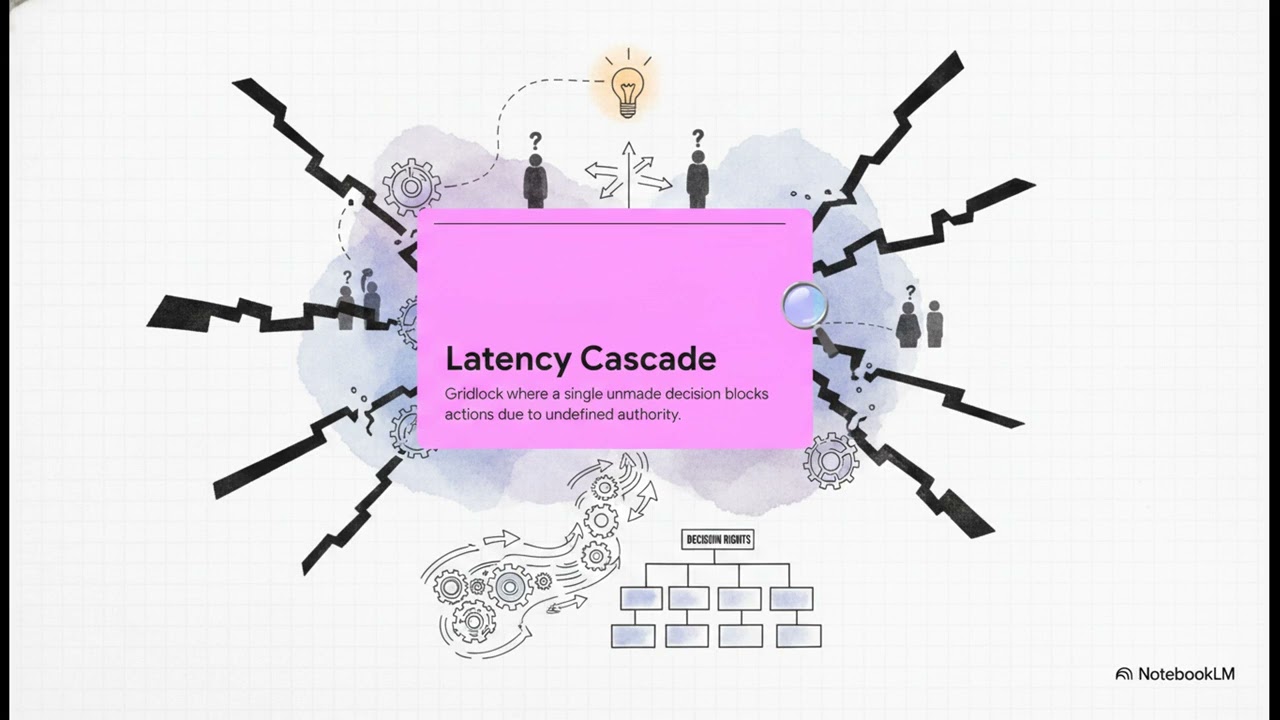
    Latency accumulates in any approval chain, and it accumulates fastest where the chain was designed for a different risk profile than the work now carries. Where the official path reliably costs more time than the task itself, an unofficial path forms to absorb the difference.

    That unofficial path is the shadow organization. It is a structural consequence rather than a cultural failing, and it appears in disciplined organizations as readily as in careless ones. The variable is process latency, not employee character.

    Prohibition does not remove the pressure that created it. Prohibition removes visibility into it, which converts a known workaround into an unknown one. The risk profile worsens while the compliance report improves.

    Normalization of deviance

    The sociologist Diane Vaughan described the process by which the boundary of acceptable behavior widens incrementally. Each deviation that produces no immediate failure becomes evidence that the deviation is safe, and the revised boundary becomes the new baseline for the next decision.

    Vulnerability accumulates quietly under this mechanism. The organization is not aware of drifting, because at every individual step the drift was small and the outcome was acceptable. Nobody made a reckless decision, and the aggregate position is nonetheless reckless.

    This is why shadow IT resists periodic crackdowns. A crackdown resets behavior without resetting the latency that produced it, so the drift restarts from the same origin on the same gradient.

    Systems and surveillance are opposite responses

    Surveillance assumes people are the risk and answers with monitoring, approval gates, and manual review. Every action requires human inspection, which produces a hidden factory of rework and delay while addressing none of the underlying condition.

    Systems assume the structure is the risk. Security embedded into the default path means the safe route and the fast route are the same route, and compliance stops competing with delivery for the same hour.

    The distinction is testable. Where a control requires someone to remember it, the control is surveillance. Where a control operates whether or not anyone remembers, it is a system, and only the second survives sustained time pressure.

    Governed activation in practice

    Governed activation is the operating pattern that replaces gate-based control. It has four components, and the value comes from installing all four rather than the strongest one.

    Explicit decision rights come first, meaning every recurring category of technology decision has a named owner rather than a committee. Second, protective controls are built into execution rather than layered on top of it, so the safe path requires no additional step. Third, each outcome carries a single named owner who holds the consequence. Fourth, a review rhythm runs on a fixed schedule rather than on request.

    The fourth component does the quiet work. A scheduled review removes the incentive to avoid raising an issue, because raising it costs nothing that waiting would not also cost.

    Frameworks that describe the same structure

    The RACI model separates responsible, accountable, consulted, and informed roles, and its practical value here is forcing a single accountable name onto each decision class. Most implementations dilute that by assigning accountability to a group, which reproduces the committee problem inside the framework meant to prevent it.

    Zero-trust architecture makes the same structural argument in security vocabulary. It assumes the perimeter will be crossed and designs for verified access at each point rather than for a single guarded boundary. The organizational parallel is exact. Assume the process will be routed around, and design the sanctioned path so routing around it produces no advantage.

    The Theory of Constraints supplies the sequencing logic. Improving anything other than the binding constraint produces no throughput gain, and in most approval structures the binding constraint is decision latency rather than technical capacity.

    Where the latency actually accumulates

    Approval latency concentrates in three places, and measuring them is cheaper than debating them. Working through the three in order usually locates the binding one within an afternoon.

    The first is consent depth, meaning how many separate people must agree before work may begin. Each additional consent adds waiting time rather than judgment quality, and the marginal reviewer contributes least. Count the consents on a recent request and compare that number against the request’s actual exposure.

    The second is context distance, meaning how far the decision travels from the person who understands the situation. Every step of that distance requires a translation, and translations lose detail reliably. Shorten the distance where possible and document the interface where the distance is unavoidable.

    The third is queue rule absence, meaning whether incoming exception requests are ordered by a stated rule or by who asked most recently. Without a rule, urgency substitutes for importance and the loudest request wins. Aligning the queue to stated risk criteria restores order without adding reviewers.

    Alignment is what makes the sanctioned path faster

    Operational excellence in this domain is not stricter control. It is the condition where the fastest available route is also the approved one, which removes the incentive that produces shadow systems in the first place.

    That condition requires shared agreement about which risks actually matter. Where security, operations, and delivery hold different risk models, the organization enforces all three simultaneously and the combined path becomes slower than any single one would be. Coherence between those views does more for stakeholder value than any additional control layer.

    Continuity holds the gain. A path optimized once and left unmonitored accumulates new consent steps, because each individual addition looks reasonable in isolation. Periodic re-examination of the path itself, rather than of compliance with it, is what prevents the slow return of the original condition.

    Conditional rules for routing decisions

    Where a decision requires judgment about a specific situation, route it to a single named risk owner rather than to a committee. Committees are appropriate for policy and structurally unsuited to instances.

    Where a compliance control requires a separate manual action to complete, the control is not embedded and will be bypassed under time pressure. Rebuild it into the default path rather than reinforcing the reminder.

    Where ambiguity exists about who may approve an exception, speed collapses regardless of how the remainder of the process is designed. Removing the ambiguity restores it, and this is usually a documentation task rather than a reorganization.

    Speed is a safety feature

    Organizational safety does not come from performative committees or accumulated documentation. It comes from the capacity to detect a problem and act on it before it compounds, and that capacity is a direct function of decision speed.

    The inversion is worth stating plainly. A slow organization is not a careful one. It is an organization whose response time to a genuine problem is also slow, and the same latency that delays a software purchase delays an incident response.

    Rigor is compatible with speed where the rigor lives in the structure rather than in the review. Calm, consistent, pre-decided rules produce faster and better outcomes than case-by-case deliberation under pressure.

    Structure protects the operators inside it

    The argument for correcting this is not only exposure management. Staff working around a process carry personal risk for a decision the structure declined to make, and they carry it without acknowledgment or protection.

    That erodes trust and human capital simultaneously. People will absorb a demanding workload. They will not indefinitely absorb responsibility for outcomes they were never authorized to control. Servant leadership expressed operationally means placing the decision where the context sits, and then standing behind it.

    Shared understanding of who decides what is what allows technical staff to raise problems early. Where that understanding is absent, raising a problem carries ambiguous consequence, and the rational response is silence.

    The question worth asking honestly

    The useful examination is not how to eliminate shadow IT, because shadow IT is a symptom and symptoms are poor targets. It is whether the sanctioned path is faster than the workaround, because that ratio determines behavior more reliably than any policy.

    Compliance rituals should be assessed against the same standard as any other process. Ask whether each one protects the business from material risk, or protects leadership from discomfort about risk it cannot see. The two feel identical from inside a review meeting and produce opposite outcomes.

    Governance that compounds is governance that makes the correct action the easy action. Every control built that way accumulates, and the accumulated effect is an organization where speed and safety stop being a trade.

    Watch the full explainer

    https://youtu.be/4p7iq5Alb6I

    Related

    Further material on operations and fractional executive leadership from Kamyar Shah: kamyarshah.com

    For an operational diagnosis of a specific situation, the free diagnostic is at businessconsultant.services

    → 7:14 AM, Aug 3
  • Cost Cutting That Does Not Cut Cost

    Cost Cutting That Does Not Cut Cost

    When margin tightens, the reflex is to reduce headcount. Structurally that sequence is inverted. Cutting people without first auditing the process architecture removes capacity while leaving the work in place. The work then reappears somewhere less visible and more expensive.

    Two kinds of labor sit inside the same payroll line

    Value-producing labor generates output. It is the work that would still exist if every system in the organization functioned perfectly. Most cost analysis treats the entire payroll as this category, which is where the error begins.

    Compensating labor exists only to bridge gaps where protocols should be. Someone moves data between systems that do not talk to each other. Someone chases an approval that was never formally defined, or rebuilds a report because the source of record is ambiguous.

    None of that work produces output. All of it is indistinguishable from real work on a headcount line, which is why it survives every review that starts from the payroll rather than from the process.

    Compensating labor is a symptom of missing structure rather than a category of role. Removing it without repairing the structure relocates the work rather than eliminating it. The relocation is usually to someone more senior and more expensive.

    Why the headcount reflex fails structurally

    Reducing headcount treats a symptom and leaves the mechanism intact. The ability to execute reliably depends on the system underneath the people. Organizations that never build an operating system to replace direct founder oversight push all that coordination back onto individuals by default.

    The failure runs in a predictable sequence. Protocols are absent, so people compensate manually, and manual compensation consumes senior attention because escalation is the only available resolution path.

    The executive calendar then fills with internal coordination rather than external growth. Growth slows, margin tightens further, and the reflex fires again.

    Each cycle removes capacity while leaving the generating mechanism untouched. This is why cost reduction programs frequently produce a second cost reduction program eighteen months later. The first one addressed the expression rather than the cause.

    Task decomposition comes before any cut

    The corrective work starts with mapping rather than with a target number. Every recurring task gets sorted into value-producing and compensating categories. This is slow, and rushing it undermines everything downstream, because the entire subsequent decision depends on the accuracy of the split.

    Two rules make the sort reliable and repeatable. Ask what the task would look like if every adjacent system worked correctly, since compensating work disappears entirely under that condition. Then follow the task backward to the gap it exists to bridge. Compensating work always has a specific structural origin, and rigor in tracing it is what separates a real audit from a guess.

    The output is not a list of people. It is a list of structural gaps with the labor cost of each attached. That inversion is what converts a cost conversation into an operations conversation.

    Process assignment turns the map into action

    Where compensating labor exists because decision rules were never documented, the correction is documentation rather than headcount change. Writing down who decides what, and under which conditions, removes the escalation traffic that consumed the time. This is the cheapest intervention available and it is routinely skipped because it produces no visible artifact.

    Where ambiguity between departments generates constant clarification, the correction is handoff protocol definition. A handoff protocol specifies what moves, in what state, to whom, and what constitutes acceptance. Most interdepartmental friction resolves once acceptance criteria exist, because the friction was never disagreement but undefined completion.

    Where the compensating work bridges two systems that do not integrate, the correction is either integration or a documented manual protocol with a named owner. Leaving it undefined guarantees the work continues invisibly and gets attributed to someone’s workload rather than to the gap.

    Naming the frameworks that make the split legible

    Lean methodology draws exactly this distinction and calls the second category waste, specifically the waiting, motion, and defect categories that describe compensating work with precision. The value of naming it that way is that it moves the conversation off people and onto the process that produces the work.

    Activity-based costing supplies the other half. Conventional cost accounting assigns expense to departments. Activity-based costing assigns it to the activity consuming the resource, which makes compensating labor visible as a line rather than as an assumption. The two together turn an opaque payroll figure into an itemized structural bill.

    A simple value stream map is usually enough to start. Following one recurring output from request to delivery and marking every wait, handoff, and rework loop exposes more compensating labor in an afternoon than a quarter of budget review. Consistency in how the map is drawn matters more than sophistication in the tooling.

    Where alignment does the financial work

    Cost structure and strategic fit are the same conversation held in different vocabulary. A cost base aligned to what the organization actually does is smaller than one carrying the residue of what it used to do. Most cost bases carry more residue than anyone has measured.

    Shared understanding of which activities are differentiating is the precondition for that alignment. Where finance, operations, and delivery hold different answers to that question, the organization funds all three interpretations simultaneously. Coherence between those views is worth more than any single reduction target, because it determines which reductions are even the right candidates.

    Continuity matters here too. A cost base corrected once and left unmonitored drifts back, since the structural gaps that generated compensating labor regenerate it as soon as attention moves. Calm, periodic re-examination holds the gain better than an aggressive one-time programme.

    Choosing the right kind of external help

    Once structural gaps are visible, buying the wrong kind of external help wastes capital efficiently. The distinction that matters is between analysis and installation, and it is frequently blurred during the purchase.

    An adviser who delivers analysis produces a document and a set of recommendations. That is useful where the constraint is knowledge, meaning the organization does not know what to do. An operator who builds execution infrastructure produces a functioning system. That is required where the constraint is capacity, meaning the organization knows what to do and has nobody with the authority and time to install it.

    Confusing the two guarantees mismatched expectations on both sides. The resulting disappointment gets attributed to the individual rather than to the category error that produced it, which means the same mistake gets repeated with a different name.

    Conditional rules for capital allocation

    Each of the following is a diagnostic rather than a preference, and each maps a specific constraint to a specific intervention.

    Where decisions have no owner and no rhythm, the intervention is structural rather than advisory. Coaching an individual will not install a decision cadence, and a strategy document will not name owners.

    Where the constraint is individual leadership patterns rather than organizational structure, executive coaching addresses it and process work will not. These two look similar from the outside and respond to opposite treatments. Steadiness in telling them apart saves more capital than speed in choosing between them.

    Where necessary work sits outside the organization’s core competency, outsourcing is more direct than internal capability building. Building durable internal capability for work that will never differentiate the business is a slow way to spend money. Where the work is differentiating, the reverse holds and outsourcing it exports the advantage.

    Red flags that the diagnosis was wrong

    Where an intervention has been running for a full cycle and the underlying friction has not moved, the problem architecture was misidentified at the start. The common response is to fund the same intervention harder, which compounds the original error rather than correcting it.

    A second flag is displacement. Costs fall in the measured category and rise in an unmeasured one, which indicates the work was relocated rather than eliminated. This is the signature outcome of cutting compensating labor without repairing the gap, and it is invisible to any report scoped to the original category.

    A third flag is the return of the same conversation. Where a cost reduction discussion recurs on a predictable interval, the organization is treating a structural condition as a periodic event. The interval itself is the diagnostic.

    Cost discipline protects people rather than pressuring them

    The argument for this approach is not only financial. Compensating labor is experienced by the people performing it as low-value work that nobody acknowledges, because it produces no output anyone can point to. That erodes human capital quietly and steadily.

    Removing the structural gap removes that work, which is materially different from removing the person doing it. Servant leadership expressed in operational terms means fixing the system that generates meaningless work rather than asking people to absorb it with better attitude. Trust in an organization tracks whether difficult decisions are made on structure or on convenience.

    Teams distinguish between a company that cuts cost and a company that removes waste, and the distinction shows up in what happens to the survivors' workload. Where the work remains and the people do not, the message is unambiguous.

    The question worth asking instead

    The useful question is not how much can be cut, because that framing assumes the current cost base is a single undifferentiated quantity. It is not, and treating it as one guarantees the wrong reduction.

    The useful question is how much of the current cost base exists only to compensate for structure that was never built. That figure is knowable, it is usually larger than expected, and it can be removed without removing capacity. Answering it requires the decomposition work that cost pressure makes everyone want to skip.

    Cost discipline compounds the same way operational discipline does. Each structural gap closed removes its associated labor permanently rather than for one budget cycle, and the accumulated effect is a cost base that does not require periodic emergency correction.

    Watch the full explainer

    https://youtu.be/C5MiaNBJkhE

    Related

    Further material on operations and fractional executive leadership from Kamyar Shah: kamyarshah.com

    For an operational diagnosis of a specific situation, the free diagnostic is at businessconsultant.services

    → 7:14 AM, Aug 3
  • The IT Operations Bottleneck Is Rarely Technical

    The IT Operations Bottleneck Is Rarely Technical

    Most operational bottlenecks get diagnosed as capacity or tooling problems and treated by adding one or the other. Where the constraint is structural rather than technical, adding capacity makes the condition worse. Every additional person increases coordination load faster than it increases productive output.

    Headcount scaling and operational scaling are different actions

    Headcount scaling manages friction. More people absorb more of the same overhead, and the underlying system continues generating it at the same rate. The friction is not reduced, only distributed across a larger payroll, which is why the relief from a hiring round tends to fade within two quarters.

    Operational scaling changes the system so that the friction stops being produced at all. The existing team then delivers disproportionately more without any addition to headcount. Organizations reliably attempt the first when the situation calls for the second, because hiring is visible and system repair is not. Diagnose which one the constraint actually requires before approving either.

    Coordination collapse

    Early stage organizations run on informal proximity, and they run on it well. Everyone holds roughly the same context because everyone sits close enough to absorb it without a documented process. This works genuinely rather than accidentally, and its success is precisely what makes the eventual failure surprising to the people inside it.

    Coordination collapse is the point where organizational complexity outpaces that mechanism. One team now holds context another team lacks, so work that used to move on assumption requires explicit negotiation. The symptom presents as a communication breakdown. The cause is structural growth past the range where proximity worked.

    Treating the symptom produces more meetings. Treating the cause produces documented context that does not depend on who happens to be in the room. Operational excellence at this stage is mostly the discipline to write things down before the calendar absorbs the alternative. Build the second before the first consumes the week.

    Decision latency

    A second failure mode appears where decision rights were never defined. A single unmade decision blocks a long chain of dependent work. Because nobody is certain they hold the authority, routine decisions escalate upward by default.

    Without a documented operating rhythm that forces choices on a schedule, delay becomes the resting state. Leadership then experiences its calendar filling with decisions that should never have reached that level. The escalation is not a discipline failure. It is a rational response to unclear authority, and it will continue until the authority is made explicit.

    Decision latency compounds differently from other operational drag, and the difference matters for triage. Capacity problems slow work proportionally, so doubling the load roughly doubles the delay. Latency problems stop work entirely until the decision arrives, regardless of how much capacity sits idle behind the block. Treat latency as the higher priority, because it wastes capacity that has already been paid for.

    The premature automation trap

    This is the most expensive version of the mistake in a technology context. Software gets deployed on top of a process nobody has examined. The purchase feels like progress because it is concrete, dated, and easy to report.

    Automating a wasteful process does not remove the waste. It produces that waste faster and more consistently, and now carries a licence cost alongside it. Diagnosis has to precede prescription, and composure at that moment is worth more than speed.

    A related failure runs quieter and lasts longer. Where the strategic process requires one outcome and the daily workflow is sequenced for a different one, the organization generates continuous drag that nobody can locate. No tool resolves this, because the tool is faithfully executing the wrong sequence. Strategic fit between intent and workflow is checked far less often than either is checked alone, and the gap between them is where most operational cost hides.

    The improvement sequence that holds

    Lean methodology and Six Sigma disagree about a great deal, and they agree about order. Both require that waste be identified before it is engineered against, and both treat measurement as a precondition rather than a reporting exercise. The Theory of Constraints goes further and argues that improving anything other than the binding constraint produces no throughput gain at all. That shared premise is the part worth carrying into any operations decision.

    Uncover the hidden drag forces first, which usually means watching the work rather than reading the process document. Define the improvement target second, in observable terms. Redesign the process structurally to eliminate what was found, third. Only then consider tooling.

    Reversing this order produces the common outcome: a modern system performing an obsolete process, and an organization concluding that the system failed. The system did not fail. It was installed at the wrong point in the sequence.

    Conditional rules for choosing the intervention

    Match the intervention to the actual constraint rather than to the most available solution. Each of the following is a diagnostic, not a preference.

    Where variation in how a necessary task gets performed is the problem, standardize the output before automating anything. Six Sigma logic applies when the defect is inconsistency rather than speed. Where tasks generate friction but sit outside the organization’s core competency, structured outsourcing addresses it more directly than internal process work. Building internal capability for work that will never be differentiating is a slow and quiet way to spend money.

    Where the environment is uncertain and the correct sequence is not yet known, standardization is premature and will lock in a guess. Locking in a guess costs more than tolerating variation for another quarter, because the guess acquires defenders once it has been documented. Wait for the pattern to stabilize, then standardize what the work has already proven. Consistency of judgment here compounds.

    What operational coherence actually looks like

    Coherence is the condition where the strategic intent, the documented process, and the daily behavior all describe the same activity. Most organizations hold all three and no alignment between them, which is why process documentation so often surprises the people it supposedly describes. The gap is not dishonesty. It is drift that nobody was assigned to notice.

    The test is inexpensive. Ask three people at different levels to describe how a specific recurring decision gets made. Where the answers diverge, the process document is fiction and the real process lives in individual habit. That divergence is the operational debt, and it accrues interest in the form of coordination time.

    Systems exist to make behavior repeatable without supervision. A process that only functions when a specific person is watching is a dependency wearing a system’s paperwork. That distinction determines whether the organization can grow past its most senior operator. Remove that participant on paper and ask what happens next.

    Where the constraint usually sits in a technology function

    Technology operations concentrate their constraints in three places, and the distribution is consistent enough to be worth checking in order. Working through them in order usually locates the binding one. Skipping the sequence applies effort where it changes nothing.

    The first is approval depth, meaning the number of separate consents required before work can start. Each consent adds latency rather than capacity. Count the consents on a recent piece of work and compare that number to its actual risk.

    The second is context ownership, meaning whether the person who understands a system is the same person authorized to change it. Where those separate, every change requires a translation step, and translation steps lose information reliably. Reunite them where possible and document the interface where not.

    The third is queue discipline, meaning whether incoming work is prioritized by a rule or by whoever asked most recently. Absent an explicit rule, urgency substitutes for importance. Install the rule before adding people to the queue.

    Measure the system, not the effort

    Most operational reporting measures activity because activity is easy to count. Tickets closed, deployments shipped, meetings held. None of those indicate whether the system underneath is improving or degrading, and a team can raise all three while the operation gets worse. Activity metrics answer whether people are busy, which was rarely the open question.

    The measures that matter are structural. Time from request to decision exposes latency, proportion of work requiring escalation exposes unclear authority, and rework rate exposes ambiguous handoffs. Each describes the system rather than the people operating it. Each moves when the structure changes rather than when the team works harder.

    Balanced Scorecard logic applies in its original sense, which is that a single measure invites gaming while a small balanced set does not. Pick three structural measures and hold them stable long enough to see a trend.

    Structure protects the people inside it

    The argument for fixing this is not efficiency alone. Ambiguous process is absorbed by staff as personal risk, and human capital erodes under sustained ambiguity faster than under sustained workload. People tolerate a heavy quarter. They do not indefinitely tolerate not knowing whether their judgment will be supported.

    People who do not know how a decision gets made will either escalate it, wait for it, or work around it. Each response costs them time and standing, and none of the three is visible on a report. Servant leadership expressed operationally means removing that ambiguity rather than encouraging people to tolerate it.

    Trust follows structure more reliably than structure follows trust. Teams extend confidence to a system that behaves predictably, and predictability is a design output rather than a cultural aspiration. Culture work on a structural problem produces goodwill that decays at the next ambiguous decision. Fix the structure and the culture question answers itself.

    Fix the system before the crisis forces the choice

    Waiting until informal proximity collapses entirely, or until decision latency cascades into visible failure, means the restructuring happens under crisis conditions. Crisis restructuring is more expensive and produces worse decisions, because the same coordination capacity that failed is now being asked to redesign itself.

    The disciplined version is unglamorous. Map where context actually lives, then name who decides what. Install a rhythm that forces those decisions on a schedule rather than on escalation. Each element compounds, and the accumulation is what people later describe as a well run operation.

    The question worth putting to any growing organization is narrow. It is not whether the team is working hard enough, because it almost always is. It is whether the organization is adding capacity to a system that consumes it. The alternative is repairing the system and releasing the capacity already locked inside the friction.

    Watch the full explainer

    https://youtu.be/_gv_D2zRA40

    Related

    Further material on operations and fractional executive leadership from Kamyar Shah: kamyarshah.com

    For an operational diagnosis of a specific situation, the free diagnostic is at businessconsultant.services

    → 7:14 AM, Aug 3
  • IT Governance Without a CIO Is a Decision Rights Problem

    IT Governance Without a CIO Is a Decision Rights Problem

    IT governance in a company without a CIO fails for structural reasons rather than technical ones. The common correction is more process: additional committees, longer review cycles, heavier documentation. That structure produces the appearance of control while removing the single condition execution actually requires, which is a named owner holding the authority to decide.

    The bottleneck sits in authority, not capability

    Consider a leadership team that communicates openly and holds real technical competence across its functions. Vendor renewals still slip past their dates, and security exceptions still queue without resolution. The reflexive diagnosis treats this as a relationship problem and invests further in alignment work. That diagnosis is inverted, and the inversion is expensive.

    Overinvesting in consensus degrades execution rather than improving it, because the mechanism that drives completion is individual consequence. Consensus distributes consequence across a group until none of it lands anywhere in particular.

    Technology decisions expose this faster than most operational areas, since a renewal carries a date and an exception carries measurable exposure. Stakeholder value erodes quietly while the group deliberates. Diagnose the decision structure before adjusting the team.

    The accountability illusion

    Ask who owns a stalled system migration, and listen carefully to the grammar of the answer. When the response is that everyone owns it, ownership does not exist in that organization. Shared accountability and singular accountability are different structures rather than different intensities of the same structure, and the distinction is not semantic.

    Shared accountability produces continuous debate and distributes blame so that no individual carries the pressure required to force a decision. Singular accountability concentrates that pressure on one person who cannot pass it elsewhere. Partial accountability is not a weaker form of accountability but the absence of it, wearing procedural clothing. Assign the outcome to a name rather than to a function.

    The silent veto

    Where decisions require implicit unanimous consent, one participant can stall an initiative indefinitely without ever refusing it. The refusal never has to be spoken. A request for additional data, or for further socialization with stakeholders, achieves the same outcome while remaining entirely reasonable on its face. This anti-pattern consumes more calendar time than any other and leaves the least visible evidence behind it.

    Nobody obstructed anything. The initiative simply did not move, and no participant can be identified as the cause. Observable symptoms are consistent across organizations of very different sizes and sectors.

    Initiatives sit at risk without progressing, decisions reappear on successive agendas, and the same approval gets sought repeatedly from the same group. Where those three appear together, the governance structure is producing deferral rather than direction.

    Diagnose the constraint before adding process

    The reactive response to stalled technology decisions is procedural: a new steering committee, a formal intake process, an additional review board. Each addition feels like control and functions as delay. Composure matters more than speed at this point, because the wrong correction is difficult to reverse once it has been installed and staffed.

    The disciplined move is to stop and map where authority actually sits, which is rarely where the organization chart indicates. Consider the difference between a bottleneck and a constraint, since the two require opposite responses. A bottleneck is a point where flow narrows and can be widened with capacity. A constraint is a structural limit that no additional throughput resolves, and undefined decision rights are a constraint rather than a bottleneck.

    The enforcement gap

    Executive development frequently teaches leaders to optimize for influence rather than authority. Influence operates through persuasion, and persuasion makes compliance optional by construction. Where compliance is optional, directives function as suggestions, and delivery degrades in a way that presents as a culture problem while originating as a structural one.

    The causal chain is specific and repeatable across engagements. A leader is coached to prioritize comfort over authority, and the team correctly infers that instructions are negotiable. Execution slows, and the organization responds with further alignment work that reinforces the original condition. Technical staff read authority with particular accuracy, so where an owner cannot enforce a standard, that standard becomes advisory and parallel practice emerges to fill the vacuum.

    Ownership and approval are different instruments

    The systemic correction separates two roles that organizations routinely merge into one. This distinction is the operating framework, and it holds across vendor selection, architecture standards, and exception handling. Operational excellence in technology depends on it more than on tooling.

    Ownership is the non-transferable right to make the final call, and it is singular by definition. It carries the consequence, and it cannot be delegated to a group without ceasing to be ownership at all.

    Approval is a constraint check rather than a vote. It confirms that a decision sits inside defined boundaries such as budget, regulatory obligation, or security policy. The owner may proceed against an approver’s stated preference where no defined constraint has actually been breached. When approval acquires the force of a vote, every constraint holder becomes a veto holder, and the organization returns to consensus under a different name.

    Naming the framework that carries the structure

    The RACI model separates responsible, accountable, consulted, and informed roles, and its value in technology governance lies almost entirely in the second letter. Most implementations dilute the accountable role by assigning it to a committee, which reproduces the original problem inside a framework meant to solve it. The DACI variant, which names a single driver alongside the approver, holds up better under pressure because the driver role resists distribution by design.

    A decision rights matrix formalizes this across recurring decision classes rather than individual decisions. Engagements that install one report the same early effect. The volume of decisions reaching the executive calendar falls. Most of those decisions already had owners who did not know they held the authority.

    The matrix does not create authority. It makes existing authority legible, and legibility is what converts a chart into a system.

    Applying the structure to technology decisions

    For an organization running technology without a dedicated CIO, this governance layer determines outcomes more reliably than any technical assessment. Vendor commitments, tooling selection, security exceptions, and modernization sequencing all fail through the same mechanism. No individual holds the pen, so the decision routes to a committee that cannot carry consequence, and the calendar decides by default.

    The correction is procedural and inexpensive relative to what deferral costs. Name a single accountable owner for each recurring technology decision class rather than for each decision. Define what each approver is checking, explicitly and in writing, and limit them to that boundary. Set a decision deadline that expires into the owner’s judgment rather than into another meeting, because a decision right without a deadline is an invitation to defer.

    Decision rules to apply immediately

    Where a project has appeared in multiple consecutive meetings without measurable movement, remove all shared ownership language and assign one named owner with constraint-based approvals. Do this before adding any further process to the path.

    Where an approver cannot state which specific constraint they are checking, that person is a reviewer rather than a gate. Remove them from the approval path and give them visibility into the outcome instead.

    Where a technology standard is routinely bypassed, treat the bypass as evidence about the standard rather than about the people bypassing it. A standard that runs slower than the work will be routed around, and enforcement effort does not change that arithmetic.

    Governance is a cadence, not a document

    Decision rhythm is the containment structure for strategy. An organization that does not control the rhythm of its own decision making will be controlled by operational noise instead, and high meeting activity is not evidence of governance. It frequently indicates the absence of it.

    The practical form is unglamorous and consists of three elements. A standing decision forum runs on a fixed cadence. A visible register lists every open decision with an owner and a deadline attached. Anything still undecided at its deadline resolves to the named owner.

    This is process architecture rather than bureaucracy, and the difference is that each element shortens the path to a decision rather than extending it. Coherence compounds from there, because each decision made cleanly teaches the organization how the next one will be handled.

    Structure is what protects people

    The reason to install this is not administrative tidiness. Ambiguous authority is experienced by staff as personal risk, and it corrodes trust in the operating structure. People who do not know whether they may decide will escalate, wait, or build quiet workarounds. Each of those responses costs them something, and the cost is rarely visible to the leadership that created the ambiguity.

    Clear decision rights remove that exposure and protect human capital from avoidable strain. Servant leadership is expressed here as structure rather than as sentiment.

    A named owner knows the call belongs to them. An approver knows the single boundary they hold. Everyone else knows the matter is settled and can proceed.

    Structure is empathy at scale, and in technology governance it separates a team that ships from a team that hedges. Organizations that make this change consistently describe the same second-order effect, which is that technical staff begin surfacing problems earlier because raising one no longer carries ambiguous consequences.

    Accountability is an unnatural state for organizations. Groups drift toward shared ownership because shared ownership is comfortable, and that comfort is not a failure of character but a predictable response to unclear structure. Build the structure so the drift has nowhere to go.

    The organizations that govern technology well rarely hold the most sophisticated review process. They are the ones where a specific person can say yes on a specific Tuesday. Everyone already knows who that person is.

    Watch the full explainer

    https://youtu.be/kdwRFy1s9Q8

    Related

    Further material on operations, decision rights, and fractional executive leadership from Kamyar Shah: kamyarshah.com

    For an operational diagnosis of a specific situation, the free diagnostic is at businessconsultant.services

    → 7:14 AM, Aug 3
  • IT Modernization Stalls for Sequencing Reasons, Not Technical Ones

    Technology adoption is generally presented as gentle and incremental. Structurally it is neither. New technical capability produces value only where the operations underneath it have been restructured to absorb it. Without that restructuring the tool is inert, and the organization concludes the tool failed.

    Software installed on unexamined workflows

    The most common modernization failure is placing advanced software directly on top of legacy workflows nobody has inspected.

    The interface changes. The structural constraint does not. The organization now runs a modern system performing an obsolete process, and the cost of the system is added to the cost of the process rather than replacing it.

    The tool was never the variable. The sequence was.

    The agility trap

    A second failure appears where speed is pursued without strategic alignment. Individual teams move quickly, adopt tools independently, and generate visible activity.

    The outputs do not compound. They remain isolated experiments that consume organizational energy without producing accumulated advantage. Activity is mistaken for progress because activity is easier to observe.

    Avoiding this requires that each adoption connect to a defined outcome before it starts, rather than being justified retrospectively by the effort already spent.

    Passive non-compliance

    When systems fail to take hold, the explanation offered is usually attitudinal. People are described as resistant to change.

    The observable behavior is more specific. Users adopt the new tool nominally and then reconstruct their familiar legacy workflow inside it, defeating the change while appearing to comply.

    This is predictable rather than personal. Resistance concentrates where the new system increases individual effort while the benefit accrues elsewhere in the organization. Where that asymmetry exists, non-compliance is the rational response, and it can be designed against in advance.

    The adoption sequence that survives contact

    Define the operational outcome before selecting the tool.

    Engage the people whose daily work changes, before launch rather than at it.

    Plan for the predictable resistance rather than treating it as a surprise.

    Measure whether the operational outcome moved, not whether the deployment completed.

    Deployment completion and outcome achievement are frequently confused, and only one of them appears on a status report.

    Why an outside adviser with a slide deck fails

    The standard expectation is that an external adviser produces analysis and departs. Structurally an adviser cannot install operational change, because installation requires presence during the period when the new process is fragile and the old one is still available.

    Fractional leadership works where the constraint is that nobody inside holds the authority and the time to hold a new operating pattern in place until it stabilizes. It does not work as a delivery mechanism for a playbook copied from a different organization with different constraints.

    Diagnostic filters

    Where operational complexity requires daily presence to hold the pattern, a periodic engagement will not produce the outcome.

    Where the constraint is knowledge rather than execution capacity, advisory work is appropriate and embedded work is over-specified.

    Where a modernization program has produced tooling changes without measurable operational movement, the sequence was reversed and further tooling will not correct it.

    The structural question

    The useful examination is not which technology to adopt next. It is whether the operating structure underneath is capable of absorbing any new capability at all, because where it is not, every adoption produces the same result regardless of the tool selected.

    Watch the full explainer

    youtu.be/faQbZVUlY…

    Related

    Further material on operations and fractional executive leadership from Kamyar Shah: kamyarshah.com

    For an operational diagnosis of a specific situation, the free diagnostic is at businessconsultant.services

    → 4:54 PM, Aug 2
Page 1 of 10 Older Posts →
  • RSS
  • JSON Feed
  • Surprise me!