Most operational bottlenecks are diagnosed as capacity or tooling problems and treated by adding either. Where the constraint is structural rather than technical, adding capacity makes the condition worse, because every additional person increases coordination load faster than output.
Headcount scaling and operational scaling are different actions
Headcount scaling manages friction. More people absorb more of the same overhead, and the underlying system continues to generate it.
Operational scaling changes the system so the friction stops being produced. The existing team then delivers disproportionately more without additional headcount.
Organizations reliably attempt the first when the situation calls for the second. Hiring into a structural bottleneck adds coordination surface to a system that is already failing to coordinate.
Coordination collapse
Early stage organizations run on informal proximity. Everyone holds roughly the same context because everyone is close enough to absorb it without a process.
Coordination collapse is the point where organizational complexity outpaces that mechanism. One team now holds context another team lacks. Shared understanding fractures, and work that used to move on assumption now requires explicit negotiation. The symptom looks like communication breakdown. The cause is structural growth past the range where proximity worked.
Decision latency
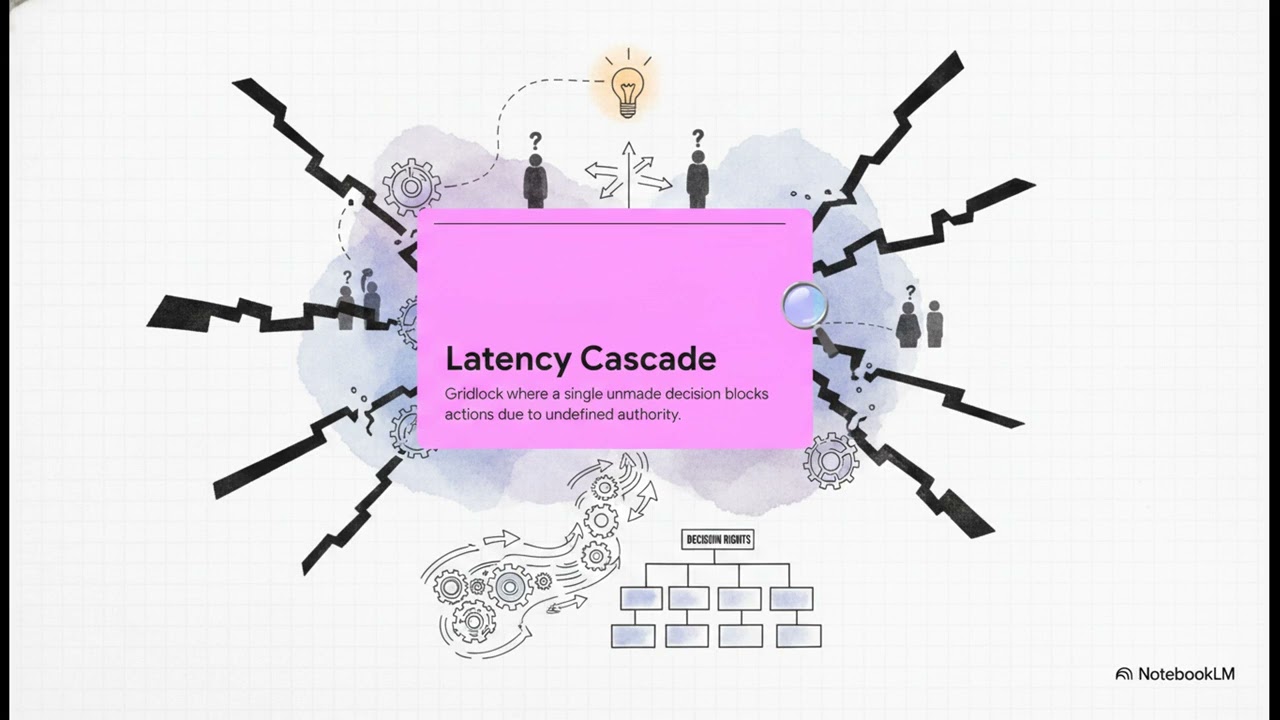
A second failure mode appears where decision rights were never defined. A single unmade decision blocks a chain of dependent work, and because nobody is certain they hold the authority to make it, routine decisions escalate upward.
Without a documented operating rhythm that forces choices on a schedule, the default outcome is delay. Leadership then experiences its calendar filling with decisions that should never have reached it.
The premature automation trap
This is the most expensive version of the mistake in a technology context. Software gets deployed on top of a process nobody has examined.
Automating a wasteful process does not remove the waste. It produces the waste faster and with greater consistency, and it now carries a licence cost and an implementation timeline. Diagnosis has to precede prescription.
A related failure: where the strategic process requires one outcome and the daily workflow is sequenced for a different one, the organization generates continuous drag that no tool resolves, because the tool is faithfully executing the wrong sequence.
Conditional rules for choosing the intervention
Match the intervention to the actual constraint rather than to the most available solution.
Where variation in how a necessary task gets performed is the problem, standardize the output before automating it.
Where tasks generate friction but fall outside the organization’s core competency, structured outsourcing addresses it more directly than internal process work.
Where the environment is uncertain and the correct sequence is not yet known, standardization is premature and will lock in a guess.
The improvement sequence
Uncover the hidden drag forces first. Define the improvement target second. Redesign the process structurally to eliminate what was found, third. Only then consider tooling.
Reversing this order produces the common outcome: a modern system performing an obsolete process, and an organization concluding that the system failed.
Fix the system before the crisis forces it
Waiting until informal proximity collapses entirely, or until decision latency cascades into visible failure, means the restructuring happens under crisis conditions rather than by design.
The question worth asking is whether the organization is adding capacity to a system that consumes it, or has the discipline to repair the system first and release the capacity already locked inside the friction.
Watch the full explainer
Related
Further material on operations and fractional executive leadership from Kamyar Shah: kamyarshah.com
For an operational diagnosis of a specific situation, the free diagnostic is at businessconsultant.services