IT governance in a company without a CIO fails for structural reasons rather than technical ones. The common correction is more process: additional committees, longer review cycles, heavier documentation. That structure produces the appearance of control while removing the single condition execution actually requires, which is a named owner holding the authority to decide.
The bottleneck sits in authority, not capability
Consider a leadership team that communicates openly and holds real technical competence across its functions. Vendor renewals still slip past their dates, and security exceptions still queue without resolution. The reflexive diagnosis treats this as a relationship problem and invests further in alignment work. That diagnosis is inverted, and the inversion is expensive.
Overinvesting in consensus degrades execution rather than improving it, because the mechanism that drives completion is individual consequence. Consensus distributes consequence across a group until none of it lands anywhere in particular. Technology decisions expose this faster than most operational areas, since a renewal carries a date and an exception carries measurable exposure. Stakeholder value erodes quietly while the group deliberates. Diagnose the decision structure before adjusting the team.
The accountability illusion
Ask who owns a stalled system migration, and listen carefully to the grammar of the answer. When the response is that everyone owns it, ownership does not exist in that organization. Shared accountability and singular accountability are different structures rather than different intensities of the same structure, and the distinction is not semantic.
Shared accountability produces continuous debate and distributes blame so that no individual carries the pressure required to force a decision. Singular accountability concentrates that pressure on one person who cannot pass it elsewhere. Partial accountability is not a weaker form of accountability but the absence of it, wearing procedural clothing. Assign the outcome to a name rather than to a function.
The silent veto
Where decisions require implicit unanimous consent, one participant can stall an initiative indefinitely without ever refusing it. The refusal never has to be spoken. A request for additional data, or for further socialization with stakeholders, achieves the same outcome while remaining entirely reasonable on its face. This anti-pattern consumes more calendar time than any other and leaves the least visible evidence behind it.
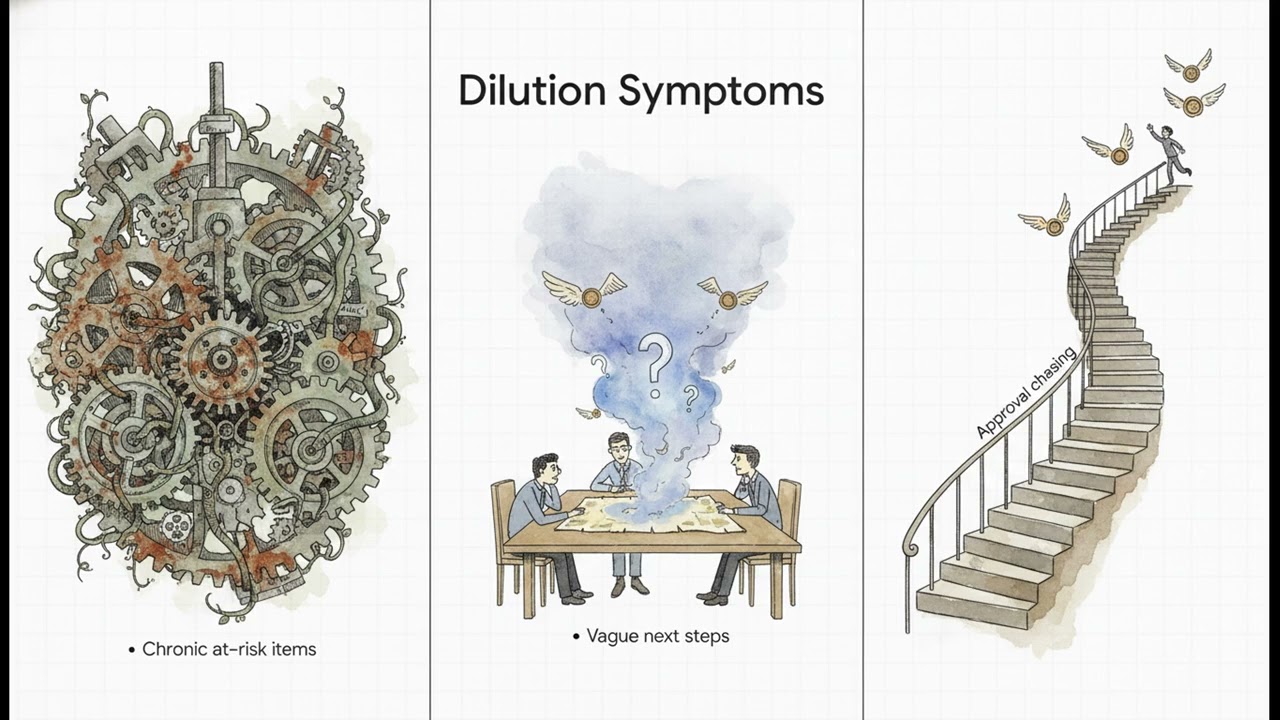
Nobody obstructed anything. The initiative simply did not move, and no participant can be identified as the cause. Observable symptoms are consistent across organizations of very different sizes and sectors. Initiatives sit at risk without progressing, decisions reappear on successive agendas, and the same approval gets sought repeatedly from the same group. Where those three appear together, the governance structure is producing deferral rather than direction.
Diagnose the constraint before adding process
The reactive response to stalled technology decisions is procedural: a new steering committee, a formal intake process, an additional review board. Each addition feels like control and functions as delay. Composure matters more than speed at this point, because the wrong correction is difficult to reverse once it has been installed and staffed.
The disciplined move is to stop and map where authority actually sits, which is rarely where the organization chart indicates. Consider the difference between a bottleneck and a constraint, since the two require opposite responses. A bottleneck is a point where flow narrows and can be widened with capacity. A constraint is a structural limit that no additional throughput resolves, and undefined decision rights are a constraint rather than a bottleneck.
The enforcement gap
Executive development frequently teaches leaders to optimize for influence rather than authority. Influence operates through persuasion, and persuasion makes compliance optional by construction. Where compliance is optional, directives function as suggestions, and delivery degrades in a way that presents as a culture problem while originating as a structural one.
The causal chain is specific and repeatable across engagements. A leader is coached to prioritize comfort over authority, and the team correctly infers that instructions are negotiable. Execution slows, and the organization responds with further alignment work that reinforces the original condition. Technical staff read authority with particular accuracy, so where an owner cannot enforce a standard, that standard becomes advisory and parallel practice emerges to fill the vacuum.
Ownership and approval are different instruments
The systemic correction separates two roles that organizations routinely merge into one. This distinction is the operating framework, and it holds across vendor selection, architecture standards, and exception handling. Operational excellence in technology depends on it more than on tooling. Ownership is the non-transferable right to make the final call, and it is singular by definition. It carries the consequence, and it cannot be delegated to a group without ceasing to be ownership at all.
Approval is a constraint check rather than a vote. It confirms that a decision sits inside defined boundaries such as budget, regulatory obligation, or security policy. The owner may proceed against an approver’s stated preference where no defined constraint has actually been breached. When approval acquires the force of a vote, every constraint holder becomes a veto holder, and the organization returns to consensus under a different name.
Naming the framework that carries the structure
The RACI model separates responsible, accountable, consulted, and informed roles, and its value in technology governance lies almost entirely in the second letter. Most implementations dilute the accountable role by assigning it to a committee, which reproduces the original problem inside a framework meant to solve it. The DACI variant, which names a single driver alongside the approver, holds up better under pressure because the driver role resists distribution by design.
A decision rights matrix formalizes this across recurring decision classes rather than individual decisions. Engagements that install one report the same early effect. The volume of decisions reaching the executive calendar falls. Most of those decisions already had owners who did not know they held the authority. The matrix does not create authority. It makes existing authority legible, and legibility is what converts a chart into a system.
Applying the structure to technology decisions
For an organization running technology without a dedicated CIO, this governance layer determines outcomes more reliably than any technical assessment. Vendor commitments, tooling selection, security exceptions, and modernization sequencing all fail through the same mechanism. No individual holds the pen, so the decision routes to a committee that cannot carry consequence, and the calendar decides by default.
The correction is procedural and inexpensive relative to what deferral costs. Name a single accountable owner for each recurring technology decision class rather than for each decision. Define what each approver is checking, explicitly and in writing, and limit them to that boundary. Set a decision deadline that expires into the owner’s judgment rather than into another meeting, because a decision right without a deadline is an invitation to defer.
Decision rules to apply immediately
Where a project has appeared in multiple consecutive meetings without measurable movement, remove all shared ownership language and assign one named owner with constraint-based approvals. Do this before adding any further process to the path.
Where an approver cannot state which specific constraint they are checking, that person is a reviewer rather than a gate. Remove them from the approval path and give them visibility into the outcome instead.
Where a technology standard is routinely bypassed, treat the bypass as evidence about the standard rather than about the people bypassing it. A standard that runs slower than the work will be routed around, and enforcement effort does not change that arithmetic.
Governance is a cadence, not a document
Decision rhythm is the containment structure for strategy. An organization that does not control the rhythm of its own decision making will be controlled by operational noise instead, and high meeting activity is not evidence of governance. It frequently indicates the absence of it.
The practical form is unglamorous and consists of three elements. A standing decision forum runs on a fixed cadence. A visible register lists every open decision with an owner and a deadline attached. Anything still undecided at its deadline resolves to the named owner. This is process architecture rather than bureaucracy, and the difference is that each element shortens the path to a decision rather than extending it. Coherence compounds from there, because each decision made cleanly teaches the organization how the next one will be handled.
Structure is what protects people
The reason to install this is not administrative tidiness. Ambiguous authority is experienced by staff as personal risk, and it corrodes trust in the operating structure. People who do not know whether they may decide will escalate, wait, or build quiet workarounds. Each of those responses costs them something, and the cost is rarely visible to the leadership that created the ambiguity.
Clear decision rights remove that exposure and protect human capital from avoidable strain. Servant leadership is expressed here as structure rather than as sentiment. A named owner knows the call belongs to them. An approver knows the single boundary they hold. Everyone else knows the matter is settled and can proceed. Structure is empathy at scale, and in technology governance it separates a team that ships from a team that hedges. Organizations that make this change consistently describe the same second-order effect, which is that technical staff begin surfacing problems earlier because raising one no longer carries ambiguous consequences.
Accountability is an unnatural state for organizations. Groups drift toward shared ownership because shared ownership is comfortable, and that comfort is not a failure of character but a predictable response to unclear structure. Build the structure so the drift has nowhere to go. The organizations that govern technology well rarely hold the most sophisticated review process. They are the ones where a specific person can say yes on a specific Tuesday. Everyone already knows who that person is.
Watch the full explainer
Related
Further material on operations, decision rights, and fractional executive leadership from Kamyar Shah: kamyarshah.com
For an operational diagnosis of a specific situation, the free diagnostic is at businessconsultant.services