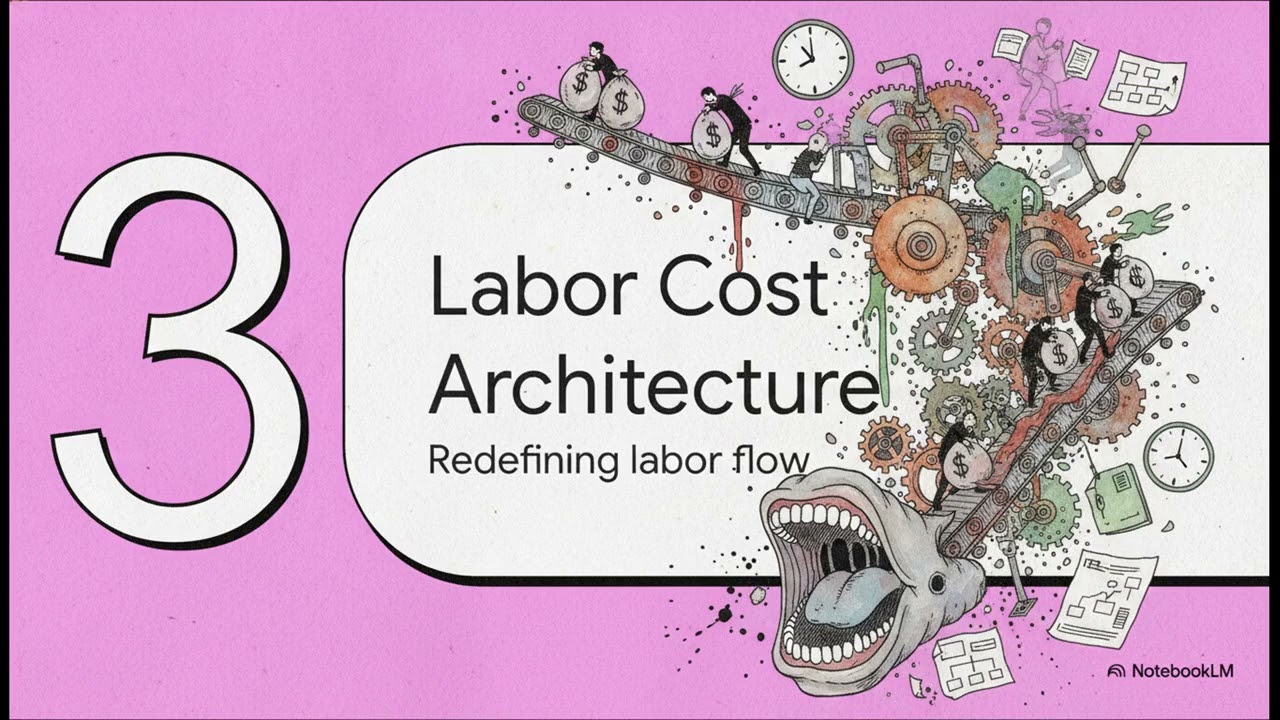
When margin tightens, the reflex is to reduce headcount. Structurally that sequence is inverted. Cutting people without first auditing the process architecture removes capacity while leaving the work in place, and the work reappears somewhere less visible and more expensive.
Two kinds of labor sit inside the same payroll line
Value-producing labor generates output. It is the work that would still exist if every system functioned perfectly.
Compensating labor exists only to bridge gaps where protocols should be. Someone moves data between systems that do not talk to each other. Someone chases an approval that was never defined. Someone rebuilds a report because the source of record is ambiguous.
Compensating labor is a symptom of missing structure. Removing it without repairing the structure relocates it rather than eliminating it, and the relocation is usually to someone more expensive.
Why the headcount reflex fails
Reducing headcount treats a symptom and leaves the cause. The ability to execute reliably requires the system underneath the people, and organizations that never build an operating system to replace direct founder oversight push all that coordination back onto individuals.
The failure runs in a predictable sequence. Protocols are absent, so people compensate manually. Manual compensation consumes senior attention. The executive calendar fills with internal coordination rather than external growth. Growth slows, margin tightens further, and the reflex fires again.
Task decomposition
The corrective work starts with mapping. Every task gets separated into value-producing and compensating categories. This is slow and it does not benefit from being rushed, because the entire subsequent decision depends on the accuracy of the split.
Process assignment follows. Where compensating labor exists purely because decision rules were never documented, the fix is documentation rather than headcount change. Where ambiguity between departments creates constant clarification traffic, the fix is handoff protocol definition.
Choosing the right external help
Once structural gaps are visible, buying the wrong kind of external help wastes capital efficiently.
An adviser who delivers analysis produces a document. An operator who builds execution infrastructure produces a functioning system. These are different purchases and they solve different problems.
Confusing the two guarantees mismatched expectations on both sides, and the resulting disappointment is usually attributed to the individual rather than to the category error that produced it.
Conditional rules for capital allocation
Where the constraint is that decisions have no owner and no rhythm, the intervention is structural rather than advisory.
Where the constraint is individual leadership patterns rather than organizational structure, coaching addresses it and process work will not.
Where the constraint is that necessary work sits outside the organization’s core competency, outsourcing is more direct than internal capability building.
Red flags that the diagnosis was wrong
Where an intervention has been running and the underlying friction has not moved, the problem architecture was misidentified at the start. Continuing to fund the same intervention harder is the common response and the wrong one.
The useful question is not how much can be cut. It is how much of the current cost base exists only to compensate for structure that was never built.
Watch the full explainer
Related
Further material on operations and fractional executive leadership from Kamyar Shah: kamyarshah.com
For an operational diagnosis of a specific situation, the free diagnostic is at businessconsultant.services